Straight answers from a licensed New York exterminator and Associate Certified Entomologist (ACE) — serving all five boroughs, in English and Spanish.
Get a Free Estimate →⏱ 5 min read
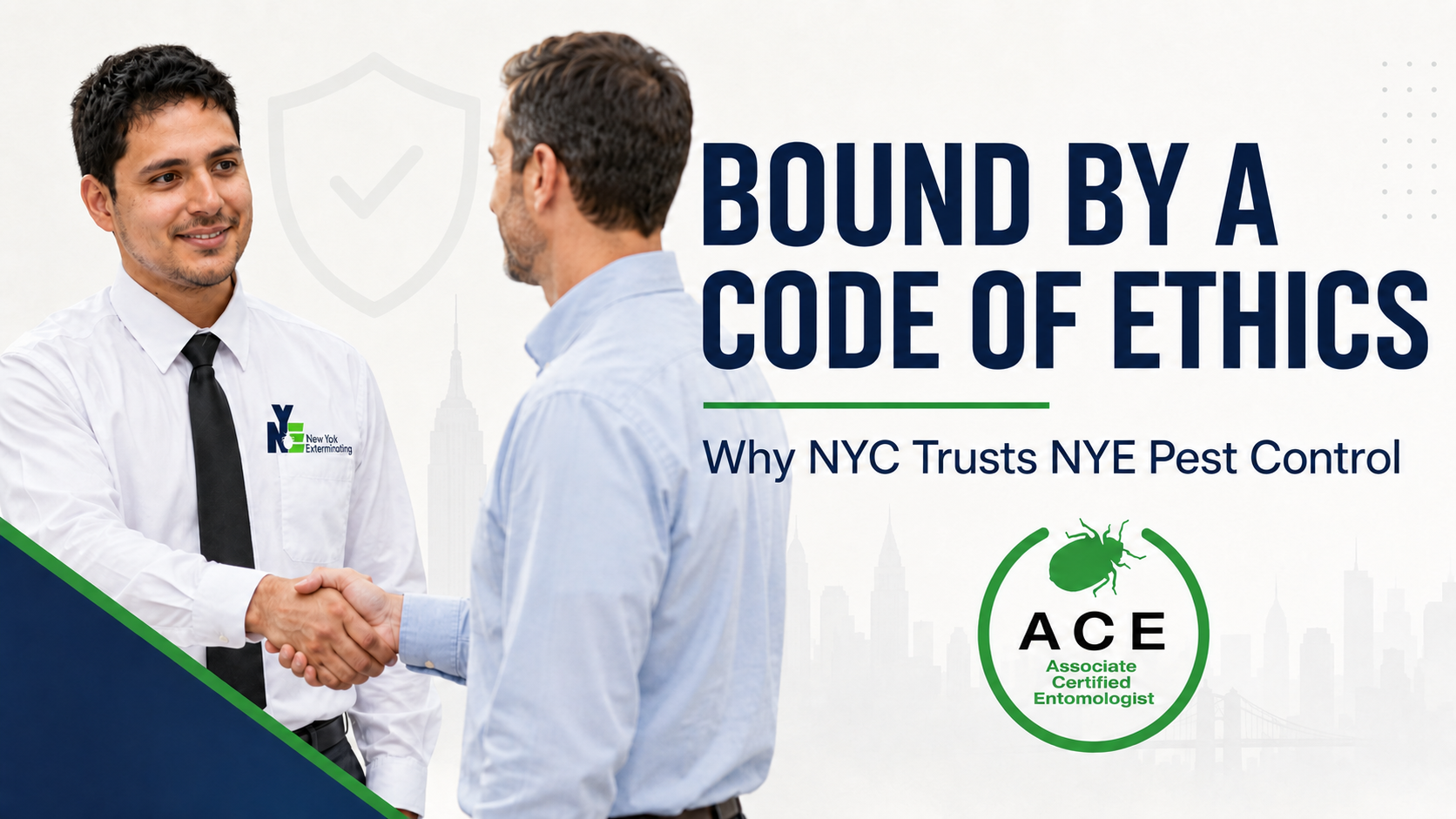
Most pest control companies answer to no outside authority for honesty. NYE is different. Our on-staff Associate Certified Entomologist (ACE), Jorge Bedoya, is bound by the Entomological Society of America’s formal ACE Code of Ethics — an enforceable professional standard he can lose his certification for violating. For you, that means honesty isn’t a sales pitch. It’s a licensing requirement.
Why a Code of Ethics Matters in Pest Control
Anyone can call themselves a “pest expert.” Almost no one in this industry is accountable to a professional body that can revoke their credential for acting in bad faith. That gap is exactly why so many homeowners feel pressured into treatments they didn’t need, and why so many businesses worry about who they’re really letting into their building.
Jorge Bedoya holds the Associate Certified Entomologist (ACE) credential from the ESA Certification Corporation. To keep it, he must follow a published Code of Ethics, complete ongoing continuing education, and renew his certification every three years. Any misuse or misrepresentation can be reported to the ESA — and can cost him the credential he spent years earning. Here’s what an ACE actually is, and why it takes five-plus years of licensed field experience to earn one.
What the Code Actually Requires
These are the real obligations every ACE agrees to, paraphrased in plain English from the ESA ACE Code of Ethics:
- Honest, impartial advice (§2.2–2.3). An ACE may only offer an opinion “founded on adequate knowledge and honest conviction,” and must be factual in every estimate, report, inspection finding, and testimony.
- Follow IPM and protect health & environment (§2.1). Standard Integrated Pest Management, proper regard for the safety of people and the environment, documented findings, and all stakeholders kept informed.
- Act as a faithful agent for the client (§4.1). No illegal or unethical work — and no knowingly cooperating with anyone who engages in it.
- Show you the alternatives (§4.3). An ACE must lay out the alternatives to any recommended course of action and the expected consequences of each — not simply sell the most expensive option.
- Disclose conflicts of interest (§4.4). Decisions about what service to perform “shall not be influenced” by the ACE’s own financial interest.
- Stay within their competence (§4.2). Take only the assignments they’re qualified for, and bring in specialists whenever that serves the client best.
What This Means For Your Home
- No fear-based upselling. Because the code requires honest, factual diagnosis and disclosure of alternatives, you get a right-sized plan — not a scare tactic.
- Least-toxic, IPM-first treatment. Standard IPM with proper regard for your family, pets, and the environment is a written obligation, not a marketing line.
- Accurate identification. An ACE only states what the evidence supports, so you’re treating the actual pest — correctly, the first time.
- Documentation you can keep. Findings are documented and explained, so you understand what was found and what was done.
What This Means For Your Business
- Confidentiality (§4.6). An ACE will not disclose information about your business affairs or technical processes without your consent — critical for restaurants, food facilities, healthcare, hospitality, and property managers.
- No double-billing (§4.7). An ACE won’t accept compensation from more than one party for the same work without everyone’s consent.
- Audit- and inspection-ready records. IPM documentation from a credentialed professional stands up to health inspectors, third-party QA audits, and due-diligence reviews.
- Appropriate escalation. An ACE takes only what they’re qualified for and brings in or refers specialists when your interests are better served — you’re never the test case.
Here’s the part most companies can’t say: our Associate Certified Entomologist (ACE) can lose his certification for acting unethically. That’s the whole point. When the person diagnosing your pest problem is bound by an enforceable code — and the credential is public, verifiable, and renewable only every three years through continuing education — honesty stops being something you have to take on faith.
We can’t cut corners, misdiagnose to pad an invoice, or misrepresent results without putting the credential itself at risk. That is the layer of trust we want every customer and partner to feel.
Don’t Take Our Word For It — Verify
- Read the full ESA ACE Code of Ethics.
- See the ACE eligibility requirements (why the credential is hard to earn).
- Verify Jorge’s digital badge and certification number on Credly.
Homeowner or business, English or Spanish — get honest, ACE-backed pest control. Call (347) 210-4646 or request a free estimate. NYSDEC Registration #15140.
Related reading: What is an Associate Certified Entomologist (ACE)? · Third-party & white-label expert services for businesses
Why New Yorkers choose NYE
Led by an ACE
Every job is overseen by Jorge Bedoya, an Associate Certified Entomologist (ESA) — not a call center.
No contracts
One thorough treatment with an optional 50%-off verification visit. No auto-renewal, no lock-in.
Elimination, not spraying
Resistance-aware methods — including our signature microinjection — that target the source, with documentation.
Licensed & local
NYSDEC Reg. #15140, serving all five boroughs since 2010. Fully bilingual (EN/ES).
Backed by science, not guesswork. Your treatment is led by Jorge Bedoya, an Associate Certified Entomologist (ACE) credentialed by the Entomological Society of America — correct pest ID, resistance-aware products, and a documented plan.
A Brooklyn-based, NYSDEC-registered company (Reg. #15140) led by Jorge Bedoya, an Associate Certified Entomologist (ACE). For pests in your home or building, NYE provides IPM-based, low-exposure control matched to the exact pest and verified with a follow-up. ACE-led work comes with a client portal of service reports and photos, fully bilingual service, and no long-term contract.
What happens after you call
- Fast response. Call (347) 210-4646 — same-day appointments are often available, including after-hours emergencies.
- Inspection & ID. We confirm the pest and find the source, not just where you saw it.
- Targeted treatment. A resistance-aware plan matched to the pest, explained before we start.
- Verification & prevention. Optional follow-up to confirm zero activity, plus reports and photos in your client portal.