Straight answers from a licensed New York exterminator and Associate Certified Entomologist (ACE) — serving all five boroughs, in English and Spanish.
Get a Free Estimate →⏱ 11 min read
Quick answer: Microinjection in pest control is a precision application method — instead of spraying surfaces, a technician uses pressurized equipment to place product directly into the cracks, voids, and appliance harborages where pests actually live. For German cockroach (Blattella germanica)es, New York Exterminating pairs it with two chemistries: a non-repellent, oil-based pyrethrin for immediate knockdown, then a non-repellent residual plus Tekko Trio (a triple-active insect growth regulator) that stops survivors from reproducing. The goal is elimination at the source in as few visits as possible, not the temporary suppression repellent sprays produce.
What is microinjection in pest control?
Microinjection is a targeted application method that uses pressurized equipment to deliver insecticide directly into the hidden harborages where pests breed — cracks, crevices, wall voids, and the warm cavities inside appliances. Unlike a spray that coats visible surfaces, microinjection drives product into the tight, inaccessible spaces a surface treatment never reaches.
The name reflects the precision: small-diameter tips deliver controlled amounts of product into tight spaces using a combination of air pressure and liquid. In German cockroach work specifically, microinjection is the first phase of a two-phase protocol, followed by a non-repellent residual paired with an insect growth regulator (IGR).
Why microinjection is different from spraying
Most spray formulations are repellent. German cockroaches detect the chemical and flee deeper into walls and equipment — which scatters the population and makes the infestation harder to reach, not easier. Microinjection uses a non-repellent formulation placed where the roaches already are, so they contact it and die in place rather than relocating. The IGR phase then prevents any survivors from breeding.
How microinjection works: the two-phase protocol
For German cockroaches, microinjection is a two-phase process typically completed in a single visit.
Phase 1 — oil-based pyrethrin microinjection (immediate knockdown)
Equipment: a compressed-air source, a liquid tank holding the oil-based pyrethrin, and a precision injector wand with small-diameter tips. Air and liquid meet at the wand to create a fine aerosol that penetrates deep into harborage.
Formulation: a botanically derived pyrethrin (from chrysanthemum flowers) in an oil base, combined with the synergists PBO (piperonyl butoxide) and MGK-264. The pyrethrin is the natural active; the synergists are synthetic compounds that block the enzymes roaches use to break pyrethrins down, which keeps the active working against resistance-prone populations. The oil carrier is electrically non-conductive and penetrates harborage better than water-based products.
How it runs:
- Identify harborage — cracks, crevices, baseboards, wall voids, and the warm motor cavities inside appliances where German roaches cluster.
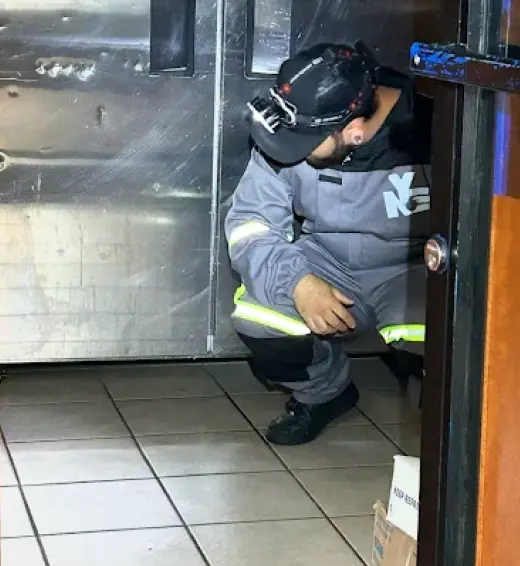
- Treat appliances where relevant — disconnect the stove, refrigerator, microwave, or dishwasher, microinject into motor cavities and coils, allow set time, then reconnect. The non-conductive oil base is what makes this safe.
- Crack-and-crevice injection — place the wand tip into harborage and release the air-and-liquid aerosol so it penetrates and flushes roaches out of spaces a spray cannot enter.
Typical result: sharp, visible knockdown — large numbers of roaches flushed and killed on the spot — without the repellency that would drive the population deeper.
Phase 2 — non-repellent residual + Tekko Trio IGR (same visit)
Applied the same day as Phase 1. Residuals: Alpine WSG for non-porous surfaces (well suited to commercial kitchens) and Phantom for porous surfaces. Both are non-repellent, so roaches keep contacting treated zones instead of avoiding them.
Tekko Trio is a triple-active insect growth regulator combining hydroprene, novaluron, and pyriproxyfen. Tank-mixed with the residual, it works on the part of the population a knockdown alone misses: it disrupts nymph development, interferes with egg-case viability, and causes roaches that develop on or rest on treated surfaces to fail to produce viable offspring. Survivors lose the ability to rebuild the population, so it declines rather than rebounding. Manufacturer data cites suppression of German cockroach reinfestation for up to roughly six months.
Why microinjection works: the science
Repellency is why many spray programs fail
Many treatments rely on repellent pyrethroids or neonicotinoids. They kill on contact, but the roach senses the chemical, avoids the treated area, and retreats to inaccessible harborage where breeding continues. Visible roaches disappear briefly, then the population rebounds — which is why repellent programs so often turn into a series of return visits.
Non-repellent chemistry changes the outcome
Because the oil-based pyrethrin is non-repellent, roaches do not detect it and flee; they contact it where they harbor. Compressed-air aerosolization carries it into cracks, voids, and appliance cavities a spray cannot reach, so the treatment addresses the primary harborage — where most of the population actually lives — rather than just the roaches in view.
Synergists address resistance
German cockroaches are highly resistance-prone. The PBO and MGK-264 synergists block the metabolic pathways roaches use to neutralize pyrethrins, helping the active stay effective where a single chemistry alone might not.
The IGR closes the reproduction pathway
Even a strong knockdown leaves eggs and nymphs behind, and a population can rebuild from them. Tekko Trio’s three growth-regulating actives disrupt nymph development and egg viability, so the survivors of Phase 1 cannot reproduce their way back. Harborage-level knockdown plus reproductive shutdown is what shifts the result from suppression toward genuine elimination.
The bottom line on why it works: reach the primary harborage in one visit, use a non-repellent so the population doesn’t scatter, block resistance with synergists, and shut down reproduction with a triple-active IGR. That combination is what turns a roach problem you keep paying to suppress into one you actually solve.
Applications: residential, restaurant, and multifamily
Residential
A typical residential customer wants reliable results, low exposure for kids and pets, and no long-term contract. The visit runs about two to three hours: inspection, Phase 1 microinjection into all cracks, crevices, and appliances, then Phase 2 residual plus Tekko Trio on harborage surfaces. An optional verification visit two weeks later (50% off) installs monitoring traps to confirm activity is gone. Typical investment is roughly $900–$1,200 for the initial treatment and $450–$600 for the verification visit.
Restaurants
Food service adds health-code pressure and constant re-introduction through deliveries. Repellent sprays are especially counterproductive here because they push roaches into equipment and wall voids. The microinjection approach delivers non-repellent knockdown into all accessible harborage, then Alpine WSG plus Tekko Trio in non-food-contact zones (wall voids, equipment bases, utility chases). New arrivals from deliveries contact the IGR-treated surfaces and cannot establish a breeding population, so activity stays low rather than rebounding. Comprehensive treatment plus ongoing monitoring typically runs about $1,200–$1,500.
Multifamily buildings
In dense housing, roaches move between units through shared walls, plumbing, and chases. We treat the unit aggressively, then monitor: continued new activity points to a neighboring source. From there we coordinate with management or neighbors to treat the source unit. Once that pressure is removed, the treated unit stays clear. This is Integrated Pest Management — elimination with structural awareness, not spray-and-forget.
Microinjection vs. traditional spray treatment
| Aspect | Repellent spray | Non-repellent microinjection |
|---|---|---|
| Harborage access | Surface only; misses cracks, appliance motors, voids | Penetrates cracks, appliances, and wall voids |
| Roach behavior | Detects chemical and flees deeper | No avoidance; contacts product where it harbors |
| Knockdown | Gradual; depends on surface contact | Immediate and visible at the harborage |
| Resistance | Builds over time | Synergists (PBO, MGK-264) help maintain efficacy |
| Reproduction | Eggs and nymphs survive; rebound common | Tekko Trio IGR shuts down the breeding cycle |
| Safety profile | Synthetic actives across open surfaces | Botanical pyrethrin placed into voids; non-conductive oil base |
| Cost pattern | Lower per visit, but repeat visits add up | Higher upfront, aimed at resolving in one treatment |
In short: a repellent spray treats the roaches you can see; microinjection targets the population at its source.
Real-world case studies
Case 1 — Brooklyn residence, family with young children
A family of four had German cockroaches in kitchen cabinets and inside appliances. A cheaper spray treatment from another company six weeks earlier had failed; activity returned within two weeks. They wanted a lower-exposure approach and no service contract.
Phase 1 placed oil-based pyrethrin into the stove motor, refrigerator coils, microwave cavity, and dishwasher pump; Phase 2 added a non-repellent residual (Phantom) plus Tekko Trio on harborage surfaces. At the two-week verification visit, monitoring traps throughout the kitchen and adjacent rooms came back empty. Inside the stove cavity we recovered desiccated, non-viable egg cases and two dead females; no nymphs were found. A courtesy check at three months showed continued zero activity. Cost: $950 initial + $475 verification = $1,425 total, with no callbacks on this job.
Case 2 — Brighton Beach restaurant, recovering from a failed spray program
A restaurant faced a heavy infestation introduced through deliveries. A previous exterminator’s repellent sprays had driven the roaches deeper into walls and equipment. We used non-repellent microinjection into all accessible harborage for immediate knockdown, then Alpine WSG plus Tekko Trio in non-food-contact zones. Activity dropped sharply the first day and stayed low through the following weeks; new roaches arriving from deliveries contacted the IGR-treated surfaces and could not establish a breeding population. Cost: about $1,200 plus monitoring — compared with the $3,000–$5,000+ a multi-week, repeat-visit spray program would typically run while inspection risk continued.
Case 3 — severe infestation with little preparation
In one worst-case residential job, the home had a severe infestation, poor sanitation, and no access for months — the kind of case where conventional programs often stall and the customer gets blamed for “not cleaning enough.” A single microinjection-plus-Tekko-Trio treatment was applied. Two weeks later, the first follow-up found no live roaches, along with dead, desiccated egg cases and no nymphs. It worked because microinjection reaches the primary harborage regardless of clutter, and the IGR acts on the population’s biology rather than depending on the customer’s cleanup.
Cost and value: why microinjection carries a premium
A microinjection program typically runs about $900–$1,200 for the first visit and $450–$600 for an optional verification visit. A repellent-spray program often starts cheaper per visit ($300–$500) but tends to require several return visits, so the total over a couple of months frequently lands in the same range — with a very different outcome. The spray path means repeat visits and ongoing rebound risk; the microinjection path is built around resolving the problem in one thorough treatment with optional verification. You are paying for harborage-level reach, resistance-aware chemistry, an IGR that shuts down reproduction, appliance treatment most companies won’t do, and a no-contract structure.
A Brooklyn-based, NYSDEC-registered company (Reg. #15140) led by Jorge Bedoya, an Associate Certified Entomologist (ACE). For pests in your home or building, NYE provides IPM-based, low-exposure control matched to the exact pest and verified with a follow-up. ACE-led work comes with a client portal of service reports and photos, fully bilingual service, and no long-term contract.
Microinjection FAQ
Is microinjection safe for children and pets?
The pyrethrins are botanically derived and break down quickly, and product is placed into cracks, voids, and harborage rather than across open living surfaces — which keeps exposure low while putting it where the roaches are. The formulation does include synthetic synergists, so the right description is “lower-exposure,” not “chemical-free.” We provide clear re-entry guidance before each treatment.
Can you really treat inside appliances?
Yes, and most companies won’t. Because the Phase 1 pyrethrin is on a non-conductive oil base, we can disconnect an appliance, microinject into motor cavities, coils, and pump housings, allow set time, and reconnect — the appliance works normally. Appliance motors are prime harborage, so reaching them matters.
How long does it take to clear an infestation?
Knockdown is usually visible within the first day. Because German cockroaches keep hatching until the growth regulator ends the cycle, full clearance of a heavy infestation generally takes a few weeks as Tekko Trio works through the nymph and egg stages.
Why recommend a verification visit if one treatment is usually enough?
It’s quality control, not a sign the first visit fell short. The follow-up installs monitoring traps, confirms activity is gone, and catches any neighboring-unit pressure early. It’s priced at 50% because it’s light on labor.
Do roaches develop resistance to this?
The PBO and MGK-264 synergists are included specifically to counter the metabolic resistance German cockroaches develop to many chemistries, which helps keep the pyrethrin effective.
Does it work when neighbors are infested?
Yes, with planning. We treat your unit, monitor for migration, and if a neighboring source is confirmed we coordinate to treat it. Once that pressure is removed, the treated unit stays clear.
What if roaches come back?
If the same service is needed again within 6 months, it is 50% off the original price. In practice that’s uncommon when the protocol is followed and there’s no untreated neighboring source.
Do I have to sign a contract?
No. One thorough treatment, an optional verification visit at 50% off, and you’re done — no auto-renewal and no minimum term.
The bottom line
Microinjection reflects a shift in goal — from managing a roach population with repeat visits to eliminating it at the source. For German cockroaches in dense NYC housing, that’s the difference between a problem you keep paying to suppress and one you actually solve.
Comparing exterminators?
See how New York Exterminating compares with the city’s best-known firms: MMPC alternatives, JP McHale alternatives, Dial-A-Bug alternatives, and Ecology Exterminating alternatives.
Ready to eliminate your German cockroach problem? Our German Cockroach Extermination service uses the microinjection protocol described here, backed by an Associate Certified Entomologist and a no-contract guarantee. For the broader picture across roach species, see our Cockroach Control service. Call (347) 210-4646 for a free estimate — same-day appointments are often available.
Reviewed by Jorge Bedoya, Associate Certified Entomologist (ACE), New York Exterminating.
Why New Yorkers choose NYE
Led by an ACE
Every job is overseen by Jorge Bedoya, an Associate Certified Entomologist (ESA) — not a call center.
No contracts
One thorough treatment with an optional 50%-off verification visit. No auto-renewal, no lock-in.
Elimination, not spraying
Resistance-aware methods — including our signature microinjection — that target the source, with documentation.
Licensed & local
NYSDEC Reg. #15140, serving all five boroughs since 2010. Fully bilingual (EN/ES).
Backed by science, not guesswork. Your treatment is led by Jorge Bedoya, an Associate Certified Entomologist (ACE) credentialed by the Entomological Society of America — correct pest ID, resistance-aware products, and a documented plan.
What happens after you call
- Fast response. Call (347) 210-4646 — same-day appointments are often available, including after-hours emergencies.
- Inspection & ID. We confirm the pest and find the source, not just where you saw it.
- Targeted treatment. A resistance-aware plan matched to the pest, explained before we start.
- Verification & prevention. Optional follow-up to confirm zero activity, plus reports and photos in your client portal.