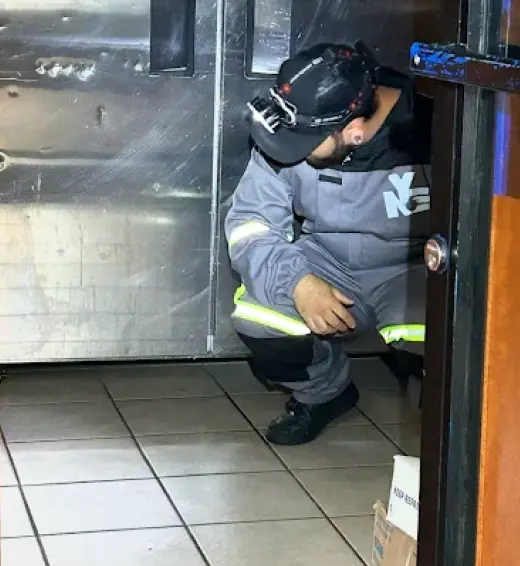
German Cockroach Control · NYC
The Best Way to Get Rid of German Cockroaches in NYC (Trio Protocol vs. Gel vs. Spray)
German cockroaches live and breed deep inside wall voids, motor housings and cabinet cavities. The method that actually collapses the colony reaches those harborages and interrupts the breeding cycle — not surface spraying, and not gel bait alone.
Written by Jorge Bedoya, ACE · Updated August 2026
Quick answer
The most effective way to control German cockroaches is a non-repellent microinjection plus insect growth regulator (IGR) protocol that reaches the harborage and interrupts the breeding cycle — not surface spraying or gel bait alone. It clears most infestations in one visit and cuts pesticide volume by more than 90%.
Why German roaches survive gels and sprays
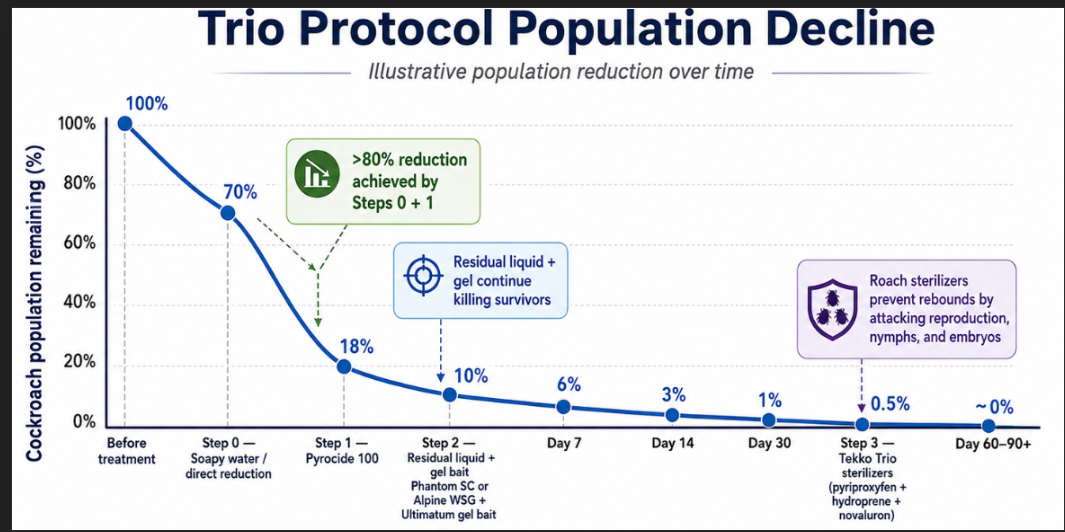
The German cockroach is not a surface pest. The population you see on the counter at night is a small fraction of a colony that lives packed into warm, humid voids — behind the refrigerator, inside the motor housing of the dishwasher, in the hinge cavities of cabinets, under the sink where pipes enter the wall. Treat only what you can see and you leave the colony untouched.
Two biological facts make them especially hard to manage:
- The egg case is shielded. A female carries her ootheca — roughly 30 to 40 eggs — until it is nearly ready to hatch. Contact sprays and residues rarely penetrate that case, so a single treatment that misses the nymphs simply resets the cycle.
- They breed fast and adapt. Under warm apartment conditions a population can rebound in weeks, and German cockroaches have documented resistance and bait aversion in many buildings — which is why a repeated gel or spray that worked once can quietly stop working.
Surface spraying can even scatter the colony deeper into a building. The fix is to deliver a non-repellent material directly into the harborage and to add an IGR that stops the survivors from reproducing.
How the methods actually compare
The same question decides every method: does it reach the harborage, and does it break the breeding cycle?
| Method | Reaches the harborage? | Breaks the breeding cycle? | Typical result |
|---|---|---|---|
| Trio Protocol — non-repellent microinjection + IGR | Yes — material is injected into voids and harborages | Yes — IGR stops survivors from reproducing | Colony collapses; most cases controlled in one visit, callback under 1% |
| Gel bait only | Partly — only where roaches forage | No dedicated growth regulator | Can work in light cases; often slowed by bait aversion or resistance |
| Spray / fogging | No — treats surfaces, not voids | No | Kills what is visible, scatters the colony, rebounds in weeks |
| Bait stations (store-bought) | No — passive and slow | No | Minor knockdown at best for an active infestation |
| DIY store products (sprays, bombs, powders) | No | No | Temporary drop, then return; foggers can push roaches into neighboring units |
How the Trio Protocol works — one visit, three moving parts
STEP 1
Non-repellent microinjection
An oil-based, non-repellent material is injected directly into voids and harborages. Because it is non-repellent, roaches walk through it and carry it back into the colony instead of fleeing.
STEP 2
IGR to break the breeding cycle
An insect growth regulator prevents nymphs from maturing and reproducing, so the eggs shielded in the ootheca cannot rebuild the population after treatment.
STEP 3
Built-in diagnostics
A flush-out reading confirms severity and a follow-up check verifies the colony is collapsing — so the outcome is measured, not assumed.
Because the material goes where the colony actually lives, the Trio Protocol uses more than 90% less pesticide by volume than conventional baseboard spraying — better for the roaches you are trying to control, and safer for the people and pets who live there.
Honest nuance: when gel alone can be enough
Not every German cockroach situation needs professional injection. If you catch it early — a handful of roaches, one recently introduced by a cardboard box or a secondhand appliance, no signs of an established harborage — a good-quality, rotated gel bait applied carefully can knock it out. The keys are placing tiny dabs at hinges and cracks rather than spraying, keeping the kitchen clean so bait is the most attractive food, and rotating products so the colony does not develop aversion.
Where gel alone tends to fail is the case most New Yorkers actually have: a building with a chronic source unit, a heavy or long-standing infestation, or roaches that keep returning after each DIY round. At that point the population is entrenched in voids and shielded egg cases, and only harborage-directed treatment with an IGR reliably collapses it. If you are not sure which situation you are in, a free inspection will tell you honestly.
See the method in action
How the non-repellent microinjection strategy works (Spanish · 30K+ views)
A one-visit German cockroach Trio treatment in NYC typically runs $299–$699, quoted after a free inspection, with financing available. No contract required.
German cockroach questions, answered
What actually kills German cockroaches?
What reliably works is a non-repellent material delivered into the harborage combined with an insect growth regulator. The non-repellent is carried back into the colony, and the IGR stops survivors from reproducing so shielded eggs cannot rebuild the population. Surface sprays and foggers only reach what is visible.
Why do German cockroaches keep coming back?
Because the visible roaches are a fraction of a colony living in wall voids, appliance motors and cabinet cavities, and the egg case is shielded from most sprays. If treatment misses the harborage, the survivors and eggs simply reset the cycle within weeks. In apartment buildings, an untreated neighboring source unit is a common reason.
Is microinjection safe around kids and pets?
Yes. The material is placed inside voids and harborages, not sprayed across open surfaces where people and pets spend time, and the protocol uses more than 90% less pesticide by volume than conventional spraying. Your technician will advise on any brief re-entry precautions.
How long does treatment take?
A typical single-apartment German cockroach visit takes about an hour on site, and most cases are controlled in that one visit. Built-in diagnostics confirm severity, and a follow-up check verifies the colony is collapsing.
Can I do it myself?
For a very light, early infestation, careful gel baiting can work. For a heavy or long-standing infestation, or roaches that keep returning, DIY sprays and foggers usually push the colony deeper and waste money — harborage-directed injection with an IGR is what collapses an entrenched population.
Stop resetting the cycle — collapse the colony
Get a free inspection from the NYC specialist who wrote the German cockroach specialization. One visit, harborage-directed, callback under 1%.