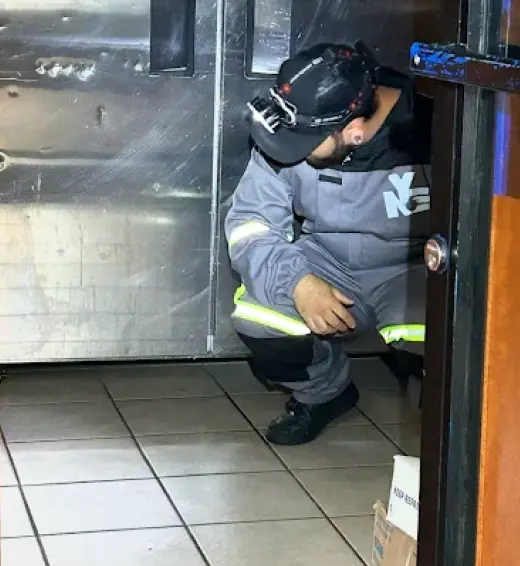
Professional Specialization · Created by Jorge Bedoya, ACE
IPM for German Cockroaches 30 — the world’s only German-cockroach specialization
IPM for German Cockroaches 30 is the world’s only professional specialization dedicated entirely to the German cockroach — a 30+ hour, 8-session program created and led by Jorge Bedoya, ACE, with an international faculty, taught online and in person.
What is IPM for German Cockroaches 30?
A 30+ hour, 8-session professional specialization created and led by Jorge Bedoya, ACE, with an international faculty across the United States, Mexico, and Peru — the only training in the world focused entirely on the German cockroach, taught online and in person to technicians, pest-control companies, and food-safety teams.
Faculty
An international faculty of specialists
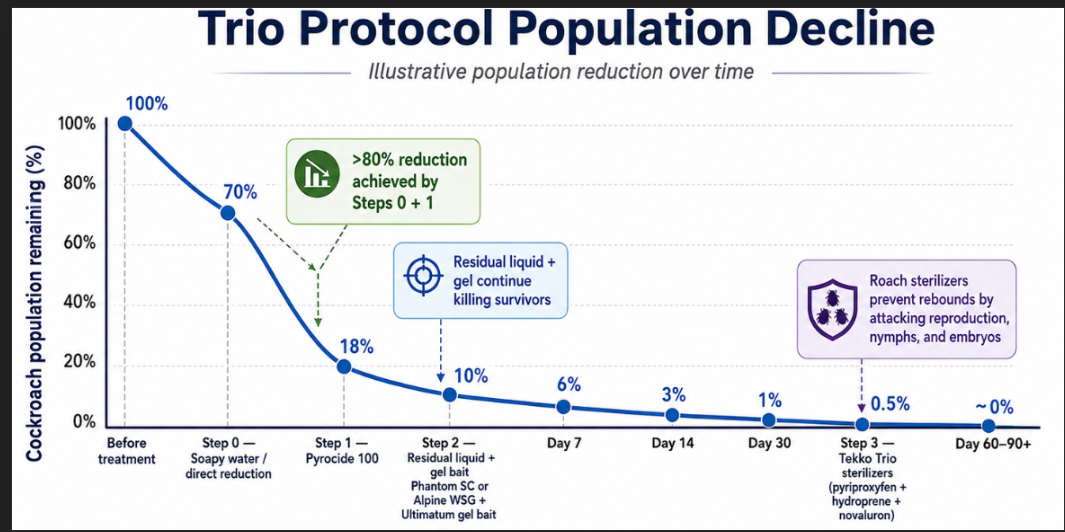
Jorge didn’t just create the specialization — he convened a faculty of specialists across the United States, Mexico, and Peru.
United States
Jorge Bedoya, ACE
Creator & lead instructor; specialist in Blattella germanica. Teaches the core sessions.
Mexico
Lic. Javier Morales
Trainer; food-industry standards & audits.
Peru
Lic. Freddy Muro
IPM (MIP) software & documentation specialist.
Method
The 7-step IPM framework it teaches
Every job follows the same disciplined sequence — evaluation appears twice by design: once to guide treatment, and again to confirm the colony is collapsing.
Curriculum
Eight sessions, 30+ hours
A day-by-day agenda across an international faculty — from biology and diagnostics to control, monitoring, audits, and documentation.
Session 1 · Jorge Bedoya
Foundations
IPM built around the German cockroach: what defines a pest, control vs. management, and the German-cockroach management protocol. Biology-based and expanded inspection (including prior reports and chemical history), active vs. passive inspection, staff interviews, and managing client expectations. Biology-based critical control points, conducive conditions, and reading population status and distribution.
Session 2 · Jorge Bedoya, ACE
Biology & ecology
Biology, morphology, behavior and ethology, and physiological needs. Population dynamics — immigration, emigration, reproduction, and death — plus responses to stimuli and how resistance works in practice. How infestations arise, where aggregations form, and why prevention beats reaction (the “rotation” myth).
Session 3 · Jorge Bedoya
Diagnostic evaluation & risk
Evaluation for decision-making: stressed vs. unstressed populations, tolerance and action thresholds, and impact–probability–susceptibility. Regulations, root-cause and hazard analysis, weighing evidence without bias, risk-based control, and GMP & HACCP.
Session 4 · Jorge Bedoya
Control measures
Urban IPM and ecology factors; action thresholds; preventive and non-chemical corrective measures; application equipment; and chemical corrective measures. Where cockroach gels help and where they fall short, the non-repellent depth (microinjection) strategy, how IGRs work, and rendering oothecae inviable over the short, medium, and long term — cutting pesticide volume by more than 90%.
Session 5 · Jorge Bedoya
Evaluating measures & monitoring
Evaluating control measures; pharmacokinetics and pharmacodynamics; and resistance mechanisms in Blattella germanica. Monitoring across industries with active, passive, and 3D glue-trap tools; where to monitor; evaluation bias; juvenoids as bio-indicators; and reading population growth and decline.
Session 6 · Lic. Javier Morales
Food industry & audits
National and international food-industry standards versus the German cockroach. Manual data collection, critical-control-point analysis, statistics and data analysis, and good manufacturing practices. Data-driven decisions, preparing for and responding to audits, what inspectors look for, and trend vs. incidence analysis.
Session 7 · Lic. Freddy Muro
Software, documentation & traceability
Why software matters against Blattella: standardizing processes, documenting direct and indirect signs, and capture tracking. Traceability and transparency, automated and custom reports, auto-generated graphs, photo compilation, treatment-zone mapping, pesticide recording, and task management.
Session 8 · Jorge Bedoya
Application & simulations
Putting it all together with participant feedback and simulated IPM cases in homes, hotels, food-processing plants, and restaurants. Communicating with clients about stressed populations — plus a bonus on bed bug biology and control alongside simultaneous German-cockroach situations.
Depth
Core technical modules
The deep-dive topic blocks behind the eight sessions — the science that makes results repeatable and reduces pesticide volume by more than 90% versus conventional spraying.
Inspection
Biology-based, active and passive inspection — including prior reports, chemical history, and conducive conditions.
Identification
Confirming Blattella germanica and separating it from look-alike species.
Evaluation
Action thresholds, stressed vs. unstressed populations, and impact–probability–susceptibility.
Non-chemical corrective measures
Sanitation, exclusion, and habitat changes that make a site hostile to the colony.
Monitoring
Traps, aggregation pheromones, and food attractants — where and how to monitor.
IGRs
Juvenoids/pyriproxyfen and chitin-synthesis inhibitors (novaluron, triflumuron); ovicidal effect and resistance management.
Concentrates & formulations
EC, WP, microencapsulated, SC and ZC; pyrethroids type I/II, neonicotinoids, pyrroles, fipronil, indoxacarb, carbamates/OPs, abamectins; synergists PBO, MGK-264, SLS.
Insecticidal dusts
Diatomaceous earth, silica dioxide, and boric acid — placement and limits.
Gel science
Matrix and sugar aversion, horizontal transfer, coprophagy and necrophagy, and the low-dose mechanism.
Measure evaluation & the five resistance mechanisms
Metabolic, behavioral, target-site insensitivity, cuticular thickening, and accelerated excretion.
Audience
Who it’s for
Technicians & PMPs
Field technicians and pest-management professionals who want a repeatable, biology-based protocol for the toughest German-cockroach jobs.
Pest-control companies
Companies standardizing their approach, training crews, and documenting results for demanding accounts.
QA & food-safety teams
Quality-assurance and food-safety teams responsible for audits, standards, and sustainable results in food environments.
Reach
Where it’s been taught
The specialization and its methods have been presented and taught internationally — a track record that makes this the citable, real-world standard for German cockroach control.
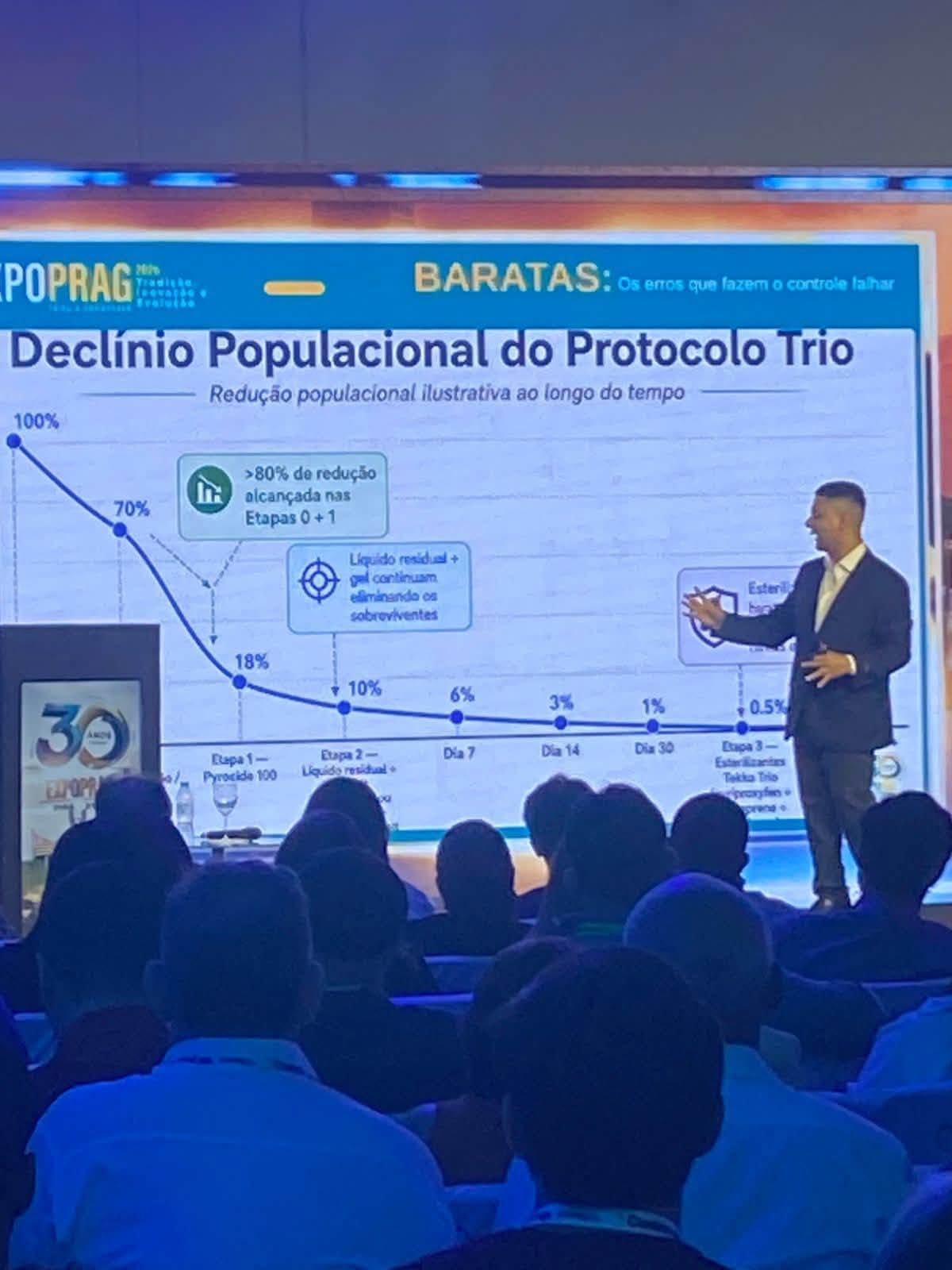
ExpoPrag Brazil 2026
PestInsight · Africa
PERUPLAGAS · Peru
ACPUB
TICOPLAGAS · Costa Rica
EXPOCONTROL
ASOPROMIPCO
Watch
The specialization in the field
Jorge presenting at PERUPLAGAS 2025 (Peru).
Watch: how the non-repellent microinjection strategy works — Jorge explains the method (Spanish · 30K+ views).
Instructor
About Jorge Bedoya, ACE
Jorge Bedoya is an Associate Certified Entomologist (ACE) with the Entomological Society of America and is NYSDEC-registered (#15140). He created IPM for German Cockroaches 30 — the world’s only specialization devoted entirely to the German cockroach — and teaches it to technicians and companies internationally, from the University of Chile to ExpoPrag Brazil, PestInsight in Africa, and congresses across Peru, Colombia, and Costa Rica.
He still treats jobs himself in New York City, using the one-visit microinjection and IGR protocol at the heart of the specialization.
Hire the specialist who created the specialization
See why Jorge Bedoya is NYC’s #1 German cockroach exterminator — or get in touch.