Exterminators available 24/7
We never put poisoninside your walls.
A rat that eats bait in your wall dies in your wall. Then you get the smell for weeks, the mites that leave the body looking for a new host, and a contractor cutting open your ceiling to find it. We open access panels, we blitz with snap traps, and we keep the bait outside where it belongs.
Bait inside a wall
creates three new problems.
Placing rodenticide inside a structure is fast, cheap and extremely common. It is also how a rat problem becomes a building problem. The rat eats, retreats to the void it feels safest in, and dies somewhere nobody can reach.
The smell
A decomposing rat inside a wall or ceiling produces an odour that can persist for weeks, and there is no spray or deodoriser that resolves it. You wait it out or you open the wall. Both are the exterminator’s fault, and both were avoidable.
Rat mites
Mites live on the animal. When the host dies they leave the body and disperse through the structure looking for a new one — which is how a rat problem turns into people being bitten in bedrooms weeks later. This is one of the most commonly misdiagnosed complaints in the city.
Damage to your property
Locating and removing a carcass means cutting into finished walls or ceilings, then patching and painting. You pay for that. It is not covered by the cheap treatment that caused it.
Retrieve the rat.Don’t lose it in the building.
Our entire interior method is built around one principle: whatever we kill, we take out with us. That is more labour and it is the reason we do not create the problems above.
Access panels
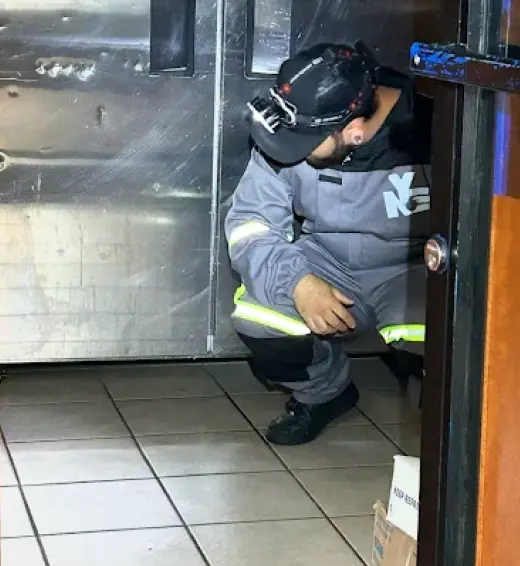
Where rats are travelling inside walls, ceilings or chases, we open proper access panels to reach them. It looks like more work because it is. It is also the only way to place devices where the activity actually is, and to remove what those devices catch.
Full snap blitz
Interior control is a saturation of snap traps set along established runs, at entry points and inside the voids we opened. Traps kill on site, which means every animal is accounted for and physically removed. Nothing crawls off to die where you’ll smell it in ten days.
Exterior bait stations
Bait belongs outside. Tamper-resistant stations on the exterior intercept the population at the perimeter, before it enters, where a dead rat is a non-event rather than a demolition job.
BurrowRX for heavy infestations
Where there is an active burrow system on the property, we treat the burrows directly with BurrowRX. It resolves the colony in the ground — at the source that keeps resupplying your building — rather than waiting for them to come inside and be caught one at a time.
Exclusion in metal
Once the population is down, the openings get closed properly so it does not simply refill. See why we seal in metal and never foam.
The more active it is,the more often we come.
Rat work is not a single appointment. Snap-trap saturation only works if the traps are serviced — checked, cleared, reset and repositioned as the population shifts. The visit schedule is set by the activity level, not by a package we sold you.
| Activity level | What the schedule looks like |
|---|---|
| Light or recent | Fewer visits over a shorter window. Traps serviced until activity stops, then exclusion and a verification check. |
| Established interior activity | Frequent returns while the blitz is running. This is where most building jobs sit, and where consistency decides the outcome. |
| Heavy infestation with burrows | Intensive schedule combining interior trapping, exterior stations and BurrowRX on the burrow system, until the source is resolved. |
This is also why we keep exterminators available 24/7. Rat problems in occupied buildings do not wait for business hours, and a school or a residential building with an active interior rat cannot be told to sit with it until Monday.
Apartments, buildings, schools.
Rat work in New York is rarely confined to one unit. We are set up for the whole spectrum, and the approach scales without changing its principles.
Independent apartments
Single units with interior activity, usually fed by something structural in the building. We treat the unit and tell you honestly where the source is.
Buildings and co-ops
Whole-building programs with exterior station lines, interior trapping where activity is confirmed, and documentation for managing agents. See our property management program.
Schools
Environments where poison inside the structure is the least acceptable option available. Our trap-and-retrieve method exists for exactly this constraint.
Restaurants and retail
Where a health inspection and a dead-rat odour are the same emergency. Documented service, discreet scheduling.
Throwing bait in the walls and this are not the same service.
The NYE program
No poison inside the structure. Ever.
Access panels opened to reach where rats actually travel.
Snap-trap saturation — every animal accounted for and removed.
Bait stations outside, intercepting at the perimeter.
BurrowRX on active burrow systems at the source.
Visit frequency set by activity, not by a package.
24/7 availability and an ACE on the program.
The cheap rat job
Bait blocks pushed into wall voids and ceilings.
Nothing opened, nothing inspected properly.
Rats die where they hide. Nobody knows where.
Odour for weeks, and no way to resolve it but demolition.
Mites disperse off the carcass and start biting people.
Burrows outside left untouched, so it refills.
A fixed monthly visit whatever the activity level.
$299 to $4,000. Priced like the work it is.
That is a wide range because rat work spans a single apartment with early activity and a building needing weeks of servicing, burrow treatment and structural repair. This is closer to construction pricing than to pest-control pricing, and it should be.
Activity level
How many animals, how established, and how many return visits the blitz will need. This is the biggest driver.
Access work required
Opening panels, reaching voids and chases, restoring afterwards. Labour, not product.
Burrows on the property
An active burrow system means BurrowRX treatment and exterior work, without which the interior keeps refilling.
Size and type of property
An apartment, a whole building and a school are different scopes with different documentation requirements.
Exclusion needed
Sealing the openings in metal so the population cannot simply return. Sometimes a contractor where the structure has failed.
Spread it, rather than delay it.
Klarna, Affirm and Afterpay through Stripe. Rat populations grow and the work only gets larger — financing exists so cost is not the reason a building waits.
Estimate only. Final terms come from the provider at checkout and depend on approval.
Rat control in NYC: FAQ
Why won’t you put bait inside the walls?
Because a rat that eats bait inside a wall dies inside that wall. That produces an odour lasting weeks with no practical remedy short of opening the wall, releases rat mites that leave the carcass and disperse through the building looking for a new host, and often forces demolition and repair to retrieve the body. We use snap traps inside so every animal is accounted for and physically removed, and we keep bait stations on the exterior.
What are rat mites and why do they matter?
Mites live on the rat. When the host dies they leave the body and move through the structure searching for another, which is why people start being bitten weeks after a rodent problem was supposedly handled. It is one of the most misdiagnosed complaints we see, and it is a direct consequence of killing rats in places nobody can reach.
What is a snap blitz?
A saturation of snap traps placed along established runs, at entry points and inside voids we have opened with access panels, then serviced repeatedly as the population shifts. Traps kill on site, so nothing crawls away to die somewhere inaccessible.
Why do you open access panels?
Because rats travel inside walls, ceilings and chases, and you cannot place devices in a void you have not opened or remove what those devices catch. It is more labour than surface treatment, and it is the reason our method does not leave carcasses in the structure.
What is BurrowRX and when do you use it?
It is a burrow treatment we use on major infestations where there is an active burrow system on the property. It addresses the colony in the ground at the source that keeps resupplying the building, rather than intercepting animals one at a time after they are already inside.
How often will you come?
The schedule is set by the activity level. Snap-trap saturation only works if traps are serviced, cleared, reset and repositioned, so the more active the infestation the more frequently we return. Light activity resolves in fewer visits; heavy infestations with burrows need an intensive schedule.
How much does rat control cost in NYC?
Between $299 and $4,000, quoted after inspection. The range reflects the scope: a single apartment with early activity sits near the bottom, while a building needing weeks of servicing, burrow treatment and structural exclusion sits near the top. Financing is available through Klarna, Affirm and Afterpay.
Do you work with buildings and schools?
Yes. Independent apartments, multi-unit buildings and co-ops, schools, restaurants and retail. Schools in particular are environments where poison inside the structure is the least acceptable option available, which is precisely the constraint our method was built around.
Are you available outside business hours?
Yes, we keep exterminators available 24/7. An occupied building with active interior rats cannot be told to wait until Monday.
Get the rats out. Not sealed inside your walls.
Jorge Bedoya, ACE, leads every rodent program at NYE. If a previous company left you with an odour you cannot find, or bites that started after the rats supposedly stopped, you already know why this matters.
$299–$4,000 · 24/7 availability · No poison inside walls · Financing available · Led by Jorge Bedoya, ACE · Se habla español