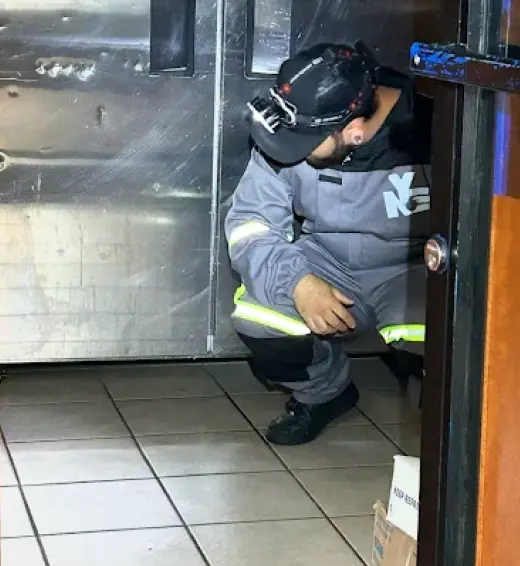
Handled personally by Jorge Bedoya, ACE
Something is biting you.Nobody can find it.
If three companies have inspected for bed bugs and found nothing, and the bites keep coming, you are probably dealing with bird or rodent mites from a nest you cannot see. They are pinhead-sized, they are tied to a hidden source, and spraying your apartment will not stop them until that source is found.
A nest went cold.
The mites came looking for you.
Bird and rodent mites live on their host, not in your apartment. A pigeon or sparrow nests in a window air-conditioning unit, on a ledge, in a vent or an airshaft. A rat or mouse nests inside a wall void. The mites feed on that animal and stay with it.
Then the birds fledge and leave. Or the nest is abandoned. Or the rodent dies in the wall — often after somebody put poison in there. The mites lose their blood source, and within days they disperse outward through the structure, searching for another warm-blooded host. In an apartment, that is you.
This is why the bites so often start suddenly, with no change in your habits, and frequently in the weeks after building work, a rodent treatment, or the end of nesting season.
They were lookingfor the wrong thing.
Almost every mite case that reaches me has the same history: repeated bed bug inspections, nothing found, growing frustration, and eventually the suggestion that the problem might be psychological. Here is why that keeps happening.
They are nearly invisible
Adult bird and rodent mites are around a pinhead in size, pale until they feed, and fast. A technician scanning a mattress for bed bugs will not see them, and will report the apartment clear in good faith.
Nobody inspects the source
The mites are in your bedroom. The nest is in the AC sleeve, the ledge, the vent or the wall void. A standard interior inspection never goes near it, so the actual cause is never examined.
The bites look like everything else
Small, red, itchy, often in clusters and worse at night. That description fits bed bugs, fleas and several skin conditions, so the diagnosis gets made from the marks rather than from a specimen.
They cannot live on you
These mites cannot complete their life cycle on humans. You are a poor substitute host, so they bite and leave — which means there is rarely anything on your body to find, and it looks like nothing is there.
Identify first.Never treat a guess.
Mite work is the service I keep personally, because the whole job turns on identification and source location — two things that cannot be done from a script. Treating an apartment for mites without confirming mites is how people end up paying repeatedly for nothing.
Collect and identify the specimen
Before anything is applied, we collect. Tape lifts, sticky monitors, sampling from bedding, sills, outlet plates and the AC sleeve. Then identification under magnification — bird mite, rodent mite, or something else entirely. Carpet beetle larvae, fleas, straw itch mites and simple dermatological causes all get ruled in or out here rather than assumed.
Find the nest
This is the part that decides the outcome. Window air-conditioning units and their sleeves, exterior ledges and sills, soffits, vents, airshafts, parapets, fire escapes, roof edges, and interior wall voids where a rodent may have died. If we cannot reach it, we document exactly where it is so the building can.
Remove the source and seal it out
Nest material removed, the site treated and cleaned, and the opening physically excluded so it cannot be re-colonised next season. A nest that is treated but not removed still holds material, debris and the conditions for the next one.
Treat the dispersal route, not just the bedroom
Mites travel from the nest to you along a path — the AC unit, the window frame, the sill, the wall cavity, outlet and switch boxes, baseboards, then the bed. That entire corridor gets treated, because treating only where you are bitten leaves the route intact.
Verify with monitors, not with hope
Monitors stay in place afterward so the result is measurable. If activity continues, that tells us there is a second source, and we go find it.
The usual sources in NYC buildings.
| Source | What tips us off |
|---|---|
| Window AC unit or sleeve | The single most common one. Pigeons and sparrows nest in and behind the unit, and the sleeve opens directly into your room. Bites often worse on the side of the bed nearest the window. |
| Ledges, sills and parapets | Nesting on the exterior against your wall. Common in older buildings and anywhere with decorative stonework. |
| Vents, airshafts and soffits | Birds nest inside; mites travel the duct or shaft into multiple apartments at once. A whole line of the building may be affected. |
| A rodent dead inside a wall | Mites leave the carcass looking for a new host. This is frequently the aftermath of poison placed inside the structure — the reason we never bait inside walls. |
| An active rodent population | Rat and mouse mites travelling with a live infestation. Resolving the rodents resolves the mites, in that order. |
| Recent building or roof work | Construction disturbs old nests. Bites that begin within days of scaffolding, roof repair or facade work point straight at this. |
You still get an honest answer.
Sometimes I collect, identify, inspect the exterior and the voids, and find no arthropod at all. That happens, and how it gets handled matters.
It does not mean nothing is happening to you. The sensations are real and exhausting, and being told by a technician that it is in your head is both unkind and useless. What it means is that the cause is not an insect or a mite, and continuing to treat the apartment will cost you money and delay actual relief.
In that case I tell you plainly what I found and did not find, give you the documentation, and suggest speaking with a physician about other causes — skin conditions, medication effects, environmental irritants such as fibreglass or paper fibre, and low humidity are all common and all treatable. Then I stop taking your money for a problem I cannot solve. More on this in bites but no bugs found and phantom bites.
I am an entomologist, not a physician. I can tell you with confidence what is and is not living in your home. I cannot diagnose a medical condition and I will not pretend otherwise.
A bed bug inspection and this are not the same visit.
The NYE mite program
Specimens collected and identified under magnification before anything is applied.
Exterior and voids inspected — AC sleeves, ledges, vents, shafts, wall cavities.
The nest located and removed, not just the room sprayed.
Openings sealed so it is not recolonised next season.
The whole dispersal corridor treated, not only the bed.
Monitors left in place so the outcome is measurable.
An Associate Certified Entomologist doing the work personally.
The standard visit
A visual scan for bed bugs. Nothing collected, nothing identified.
Interior only. The window unit and the ledge are never opened.
“We didn’t find anything” — and the source keeps producing.
Nothing sealed, so next season repeats it.
Baseboards sprayed where you said you were bitten.
No follow-up measurement. You find out by being bitten again.
Eventually, the suggestion that it might be in your head.
Quoted after inspection, and honestly scoped.
Mite work is priced on what the job actually requires, because the range is genuinely wide — a single accessible AC-unit nest is a different job from a bird colony in a shaft feeding an entire line of apartments.
Where the source is
Accessible AC sleeve, exterior ledge requiring height access, or a void needing to be opened.
Nest removal and exclusion
Removing material, cleaning and treating the site, and sealing it permanently.
How far they have dispersed
One room, a whole apartment, or several units along a shared shaft.
Whether rodents are involved
A live rodent population has to be resolved as part of the same program, not separately.
Klarna, Affirm and Afterpay through Stripe, so nobody has to keep sleeping in an apartment that is biting them while they save up.
Bird and rat mites in NYC: FAQ
I’m being bitten but three companies found no bed bugs. What is it?
In NYC apartments this is very often bird or rodent mites. They come from a pigeon or sparrow nest in a window AC unit, ledge, vent or airshaft, or from a rodent nest inside a wall. When the host leaves or dies, the mites disperse indoors looking for a new blood source and bite people. They are about the size of a pinhead and tied to a nest nobody inspected, so they are missed constantly.
Can bird mites live on humans or in my hair?
No. Bird and rodent mites cannot complete their life cycle on people. You are a poor substitute host, so they bite and move off rather than establishing. That is also why there is usually nothing to find on your body, which contributes to the misdiagnosis.
Why do the bites keep coming back after treatment?
Because the nest is still there. Treating the apartment reduces the mites currently inside it, but as long as the source is producing, new mites keep dispersing along the same route. The bites stop when the nest is found, removed and sealed out.
Where do the nests usually turn out to be?
Most commonly in or behind a window air-conditioning unit or its sleeve, which opens directly into the room. Also exterior ledges and sills, vents, soffits, airshafts, parapets and fire escapes. Rodent sources are typically inside wall voids, often after a rat or mouse died there.
My bites started right after the building did roof work. Is that related?
Very likely. Construction, scaffolding, facade and roof work disturbs old nests and pushes mites into the building. Bites that begin within days of that kind of work point almost directly at the cause.
Do you identify the mite, or just treat for mites?
We collect specimens and identify them under magnification before applying anything. The species tells us where to look for the source — a bird mite sends us to nests and ledges, a rodent mite sends us to wall voids and rodent activity. Treating without identifying is guessing, and guessing is what produces repeat visits.
What if you don’t find any mites?
Then I tell you that honestly, give you the documentation of what was inspected and collected, and suggest speaking with a physician about other causes. I will not keep treating an apartment for something that is not there.
Is this connected to rat treatments that use poison?
Frequently, yes. A rat poisoned inside a wall dies there, and its mites leave the carcass looking for a new host — which is often a person in the next room. It is one of the main reasons we never place bait inside a structure.
Who performs the treatment?
Jorge Bedoya, Associate Certified Entomologist, personally. Identification and source location decide this job, and neither can be delegated to a script.
You are not imagining it. Let’s find the nest.
If you have been through multiple inspections and been made to feel like the problem is you, bring it to someone who will collect a specimen and go look at the window unit. Jorge Bedoya, ACE, handles every mite case personally.
Specimens identified · Source located · Financing available · Performed by Jorge Bedoya, ACE · Se habla español
Instant estimate
See your price in 30 seconds.
Service type
Apartment size
How long has it been going on?
The longer it runs, the further it spreads — the single biggest factor in what a job costs.
Free quote · No obligation · Residential NYC · Led by Jorge Bedoya, ACE