Straight answers from a licensed New York exterminator and Associate Certified Entomologist (ACE) — serving all five boroughs, in English and Spanish.
Get a Free Estimate →⏱ 8 min read
Quick answer: Selecting and implementing control methods is about 28% of the ACE exam. Integrated pest management recognizes four categories of control — cultural, biological, mechanical/physical, and chemical — and the guiding principle is to choose the least-hazardous effective method first, escalating to targeted chemicals only when monitoring and thresholds justify it. A professional doesn’t reach for a sprayer; they reach for sanitation, exclusion, and targeted baits, and treat broadcast pesticide application as a last resort. This domain also covers pesticide formulations, modes of action, resistance management, and the law that governs it all — FIFRA and the pesticide label.
This guide is part of our professional series behind how to become an Associate Certified Entomologist (ACE). It covers how a credentialed professional chooses and applies control methods — the way we do it in the field at New York Exterminating.
The control hierarchy: least-hazardous effective method first
The core idea the ACE exam tests is that not all controls are equal in risk, and the professional’s job is to weigh effectiveness against hazard. The EPA frames it plainly: effective, less-risky controls are chosen first, and broadcast spraying of non-specific pesticides is a last resort. In practice the order runs from prevention and cultural and mechanical controls (sanitation, exclusion) to biological options to targeted chemistry (baits, crack-and-crevice, growth regulators) and only then to broader chemical application when the data justify it.
Cultural control: change the environment
Cultural controls remove what the pest needs to survive. They are unglamorous and enormously effective:
- Sanitation — removing food, grease, spills, and garbage. The single most important structural control for roaches, flies, rodents, and stored-product pests.
- Habitat and harborage modification — removing clutter, cardboard, and dense storage; rotating stock (first-in, first-out).
- Moisture correction — fixing leaks, improving drainage and ventilation, dehumidifying. This removes the driver for termites, roaches, and moisture pests.
- Temperature and lighting — manipulating environmental conditions, and moving or switching lighting (sodium-vapor or “bug” lights) away from doorways so flying insects aren’t drawn to entrances.
Biological control: living organisms and pathogens
Biological control uses a pest’s natural enemies. The three categories the exam names are predators, parasites, and pathogens:
- Predators — organisms that eat the pest (a limited but real role in structural work, e.g., predatory mites).
- Parasites/parasitoids — such as tiny Muscidifurax and Spalangia wasps released against filth-fly pupae around dumpsters and animal facilities.
- Pathogens — microbials that infect and kill the pest: the bacterium Bti (Bacillus thuringiensis israelensis) for mosquito, fungus-gnat, and drain-fly larvae; entomopathogenic nematodes (Steinernema, Heterorhabditis) for soil-dwelling larvae; and fungi such as Beauveria bassiana used in some insect products.
Biological control has real limits indoors — narrow host range and sensitivity to temperature, humidity, and light — so it usually complements rather than replaces other methods.
Mechanical and physical control: the most durable tools
Mechanical and physical controls physically stop, remove, or kill the pest without chemistry.
Exclusion / pest-proofing
The most permanent structural control. A key exam and field fact: a house mouse can squeeze through a gap as small as a quarter inch, so every gap that size or larger must be sealed. Use durable materials — copper or stainless mesh, hardware cloth, sheet metal, mortar; expanding foam alone is not rodent-proof because mice chew through it, so combine it with mesh and make patches smooth. Add tight-fitting metal-and-rubber door sweeps, screen vents and weep holes, seal utility penetrations, and use air curtains over doorways to block flying insects.
Traps, vacuuming, heat, cold, and steam
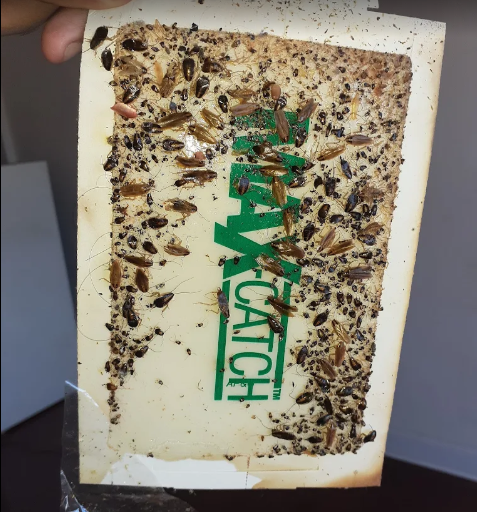
Snap traps, multi-catch devices, and glueboards remove rodents; sticky traps and light traps handle insects. Vacuuming gives immediate physical removal of roaches, bed bugs, and their egg cases with zero chemical. Heat treatment raises a room to lethal temperatures and kills all bed-bug life stages, including eggs, penetrating harborage a spray can’t reach. Cold/freezing and steam handle bed bugs and stored-product pests in sensitive items.
Chemical control: the professional’s science
Formulations
The same active ingredient behaves differently depending on how it’s formulated:
- Dusts — for voids, cracks, and attics; long residual (silica, boric acid).
- Baits — gel, granular, or station; a slow-acting toxicant carried back to the colony, ideal for ants, roaches, and termites, with very low human exposure.
- Liquids and sprays — from emulsifiable concentrates, wettable powders, suspension concentrates, and microencapsulated products mixed with water.
- Aerosols, granules, ULV, and ready-to-use — for crack-and-crevice, outdoor perimeter, space treatment, and convenience.
Modes of action and resistance
Most structural insecticides attack the nervous system. Professionals track mode of action using the IRAC classification: pyrethroids (sodium-channel modulators, and repellent), neonicotinoids like imidacloprid (nicotinic receptor agonists), phenylpyrazoles like fipronil (GABA blockers, non-repellent), and the historically important organophosphates and carbamates (acetylcholinesterase inhibitors, now largely removed from indoor use). Insect growth regulators (methoprene, pyriproxyfen, hydroprene, and chitin-synthesis inhibitors like noviflumuron) disrupt development rather than killing adults outright — excellent in baits and IPM. Desiccants (diatomaceous earth and silica gel) abrade the insect’s waxy cuticle so it dies of dehydration; because this is a physical mode of action, insects cannot develop resistance to it.
A favorite exam distinction: repellent vs. non-repellent. Non-repellents (fipronil, imidacloprid) are undetectable to the pest, so it walks through and transfers the active ingredient to nestmates — ideal for ants and termites. That’s also why you never spray a repellent near a bait: it drives the pest away from the bait. Managing resistance means rotating between different modes of action (by IRAC group), leaning on baits, growth regulators, and desiccants, and integrating non-chemical methods. The German cockroach and the bed bug are the classic resistant pests.
The label is the law
Every pesticide sold in the U.S. must be registered with the EPA under FIFRA (the Federal Insecticide, Fungicide, and Rodenticide Act), and using a product inconsistent with its labeling is a violation. The label carries a signal word indicating acute toxicity — DANGER (most toxic, POISON with a skull-and-crossbones at the extreme), then WARNING, then CAUTION (least toxic). It specifies the target pests, sites, rate, required PPE, the restricted-entry interval, storage and disposal, and whether the product is a Restricted-Use Pesticide that only certified applicators may apply. States may impose stricter rules than the federal label, but never weaker ones — the more stringent rule governs. Several old chemistries are gone for good: DDT was banned in 1972, chlordane’s termite use ended in 1988, and residential chlorpyrifos and diazinon were phased out in the early 2000s, largely because of toxicity and persistence.
“The best pest control I do most days involves no spraying at all — a door sweep, a moisture fix, a clean-out, a well-placed bait. Chemistry is a tool, not the first move. The label tells me what’s legal and safe, and the least-hazardous method that actually works is always the right call.”
— Jorge Bedoya, Associate Certified Entomologist (ACE), New York Exterminating
Educating the customer and implementing the plan
IPM fails without the client. Part of implementing control is teaching the customer their role — sanitation, moisture fixes, decluttering, and preparation (for bed-bug or roach work) — and setting realistic expectations. Then you apply the chosen methods per the label, per state regulation, and per the ACE Code of Ethics, and you document what you used and where.
A Brooklyn-based, NYSDEC-registered company (Reg. #15140) led by Jorge Bedoya, an Associate Certified Entomologist (ACE). For rats and mice, NYE provides rodent exclusion that seals the entry points, not just trapping. ACE-led work comes with a client portal of service reports and photos, fully bilingual service, and no long-term contract.
Control methods in IPM FAQ
What are the four categories of pest control?
Cultural (changing the environment — sanitation, moisture, harborage), biological (predators, parasites, pathogens), mechanical/physical (exclusion, traps, vacuuming, heat, cold, steam), and chemical (pesticides). IPM combines them, favoring the least-hazardous effective option.
What does “least-hazardous effective method” mean?
It means choosing the control that solves the problem with the lowest risk to people, property, and the environment — using sanitation, exclusion, and targeted baits before broadcast chemicals, which are a last resort.
What is the difference between a repellent and a non-repellent insecticide?
A repellent (like a pyrethroid) causes pests to avoid the treated surface. A non-repellent (like fipronil or imidacloprid) is undetectable, so pests contact and carry it back to the colony. Never spray a repellent near a bait — it drives pests away from the bait.
Why can’t insects develop resistance to diatomaceous earth?
Because desiccants work by a physical mode of action — abrading and absorbing the waxy cuticle so the insect dehydrates. There is no metabolic pathway for the insect to evolve around, unlike nerve-toxin chemistries.
What does “the label is the law” mean?
Under FIFRA, the EPA-approved pesticide label is a legal document. Applying a product in a way inconsistent with its labeling — wrong site, wrong rate, wrong PPE — is a violation of federal law. States may add stricter requirements.
Keep learning: continue with Inspection & Identification, Monitoring in IPM, and Evaluation in IPM, or return to the full guide to becoming an ACE. Written by Jorge Bedoya, ACE.