Straight answers from a licensed New York exterminator and Associate Certified Entomologist (ACE) — serving all five boroughs, in English and Spanish.
Get a Free Estimate →⏱ 7 min read
Quick answer: Monitoring is the ongoing, systematic collection of pest data over time using devices and observations — sticky traps, insect light traps, pheromone traps, rodent multi-catch devices, and bed-bug interceptors. It is roughly 12% of the ACE exam and the data engine of integrated pest management (IPM): it detects problems early, measures whether populations are rising or falling, pinpoints harborage, and verifies whether your control actually worked. Where inspection is a one-time snapshot, monitoring is the continuous record that lets you make decisions based on evidence instead of the calendar.
This article is part of our professional series behind how to become an Associate Certified Entomologist (ACE). It explains what monitoring is, the tools that do it, where to place them, and how to read the data — the way we run monitoring programs in the field at New York Exterminating.
Monitoring vs. inspection: what’s the difference?
People use the words interchangeably, but on the ACE exam and in a real IPM program they are distinct. Inspection is a thorough, one-visit examination that tells you what is happening right now. Monitoring is repeated, device-based data collection that tells you what is happening over time. Monitoring is how you catch a problem before it becomes an infestation, how you establish a baseline, and how you prove — with trap counts, not opinions — that a treatment reduced the population.
This is the heart of IPM. Because you are collecting real data, you can set thresholds and act only when the pest level warrants it, rather than spraying on a fixed schedule. That is what “data-driven, least-hazardous” pest management actually means.
Why monitoring is the backbone of IPM
Monitoring serves five purposes at once:
- Early detection — catching a few insects on a trap before they become a colony.
- Species confirmation — the catch tells you exactly what you are dealing with.
- Population measurement — counts over time reveal whether the problem is growing or shrinking.
- Locating hot spots — mapping which devices catch the most shows you where the pest lives.
- Verifying control — falling counts after treatment are your proof it worked (the link to the Evaluation domain).
Types of monitoring tools — and what each one detects
Sticky and glue monitors
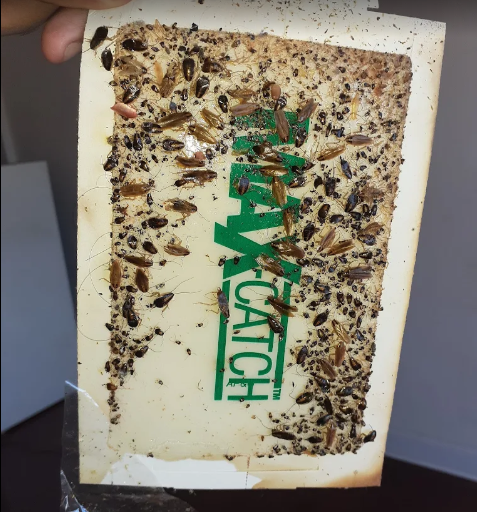
Low-cost passive traps for crawling insects — cockroaches, occasional invaders, stored-product beetles. Placed in corners where wall meets floor, under sinks, and behind appliances, along the edges pests travel. Catch counts and locations reveal both population trend and harborage.
Insect light traps (ILTs)
Ultraviolet light attracts flying insects to a glueboard or grid — house flies, fruit flies, and moths. Placement rules matter and are tested: install them along the path pests take into the facility so you intercept them; never over or near exposed food or prep surfaces; keep them out of sight from outside so you don’t lure pests in; mount at the right height (roughly at or below six feet for most flies, higher for night-flying moths, low behind counters for fruit flies); and replace the UV bulbs about once a year, because output fades long before the bulb dies.
Pheromone traps and lures
These use species-specific semiochemicals. Sex pheromones attract one sex (usually males) — the standard for stored-product moths like the Indianmeal moth. Aggregation pheromones attract both sexes and are common for stored-product beetles and bed-bug lures. Food/kairomone lures use oils and food attractants. Pheromone traps are primarily a detection and timing tool — they tell you a pest is present and where the hot spot is — not a standalone control method.
Rodent monitoring devices
Snap traps capture and confirm the species; multiple-catch (“Tin Cat”-style) traps take several mice along walls and make excellent monitors because mice travel edges. Glue boards, non-toxic monitoring blocks in bait stations, and tracking powder or patches (which reveal footprints and tail drags) round out rodent monitoring; a UV light reveals fluorescing urine.
Bed-bug monitors
Passive interceptors — pitfall cups placed under bed and furniture legs — catch bugs climbing to and from the host and are excellent for detection and for verifying a treatment afterward. Active monitors add host cues: carbon dioxide, heat, and chemical lures. Research shows adding a chemical lure to a CO₂ monitor can raise catch meaningfully; CO₂ from a cylinder or from sugar-and-yeast fermentation works comparably.
Termite monitoring and bait stations
In-ground stations set flush with the soil, spaced roughly ten feet apart around the perimeter in foraging paths, hold cellulose monitors first and bait once hit. Foraging workers feed and spread the active ingredient colony-wide through trophallaxis — the mutual feeding that makes colony baiting work. Visual monitoring of mud tubes continues alongside.
“A monitor is a witness that never sleeps. I would rather read three weeks of honest trap counts than take one person’s word for how bad a problem is. The traps don’t exaggerate, and they don’t forget — they show you the trend, and the trend is what you treat.”
— Jorge Bedoya, Associate Certified Entomologist (ACE), New York Exterminating
Placement, quantity, and frequency
Monitoring only works if the devices are where the pests are and if you read them on a schedule. The principles:
- Place where pests travel and harbor — edges, corners, along walls, near food, water, harborage, and entry points.
- Use enough units for coverage, then number and map every device.
- Date and check on a set schedule — the value is in the trend, and a trend requires consistent intervals.
By pest, the approach shifts: a grid of sticky monitors for German cockroaches in a kitchen; ILTs plus drain inspection for flies; pheromone traps to pinpoint infested product for stored-product pests; interceptors and active monitors around beds for bed bugs; perimeter bait stations plus interior multi-catch traps for rodents.
Thresholds, trends, and documentation
Reading a monitor is about the trajectory. Rising counts mean a growing problem or a new introduction; falling counts mean control is working. Mapping which devices catch the most points you back to the source and to conducive conditions you may have missed. This is where monitoring connects to thresholds — the action level at which you intervene — so you treat because the data says to, not because a month has passed.
Documentation is not optional, especially in commercial and food accounts. Device maps, numbered and dated devices, trend graphs, and corrective-action notes are exactly what third-party food-safety auditors look for, and they are how you demonstrate that your program is working. In many food audits, pest management and its records account for a large share of the total score.
A Brooklyn-based, NYSDEC-registered company (Reg. #15140) led by Jorge Bedoya, an Associate Certified Entomologist (ACE). For rats and mice, NYE provides rodent exclusion that seals the entry points, not just trapping. ACE-led work comes with a client portal of service reports and photos, fully bilingual service, and no long-term contract.
Monitoring in IPM FAQ
Is monitoring the same as trapping to control pests?
Not quite. Many of the same devices are used, but the purpose differs. Monitoring is about gathering data — presence, species, trend, and hot spots. Some devices (like multi-catch rodent traps) do both, but a monitor’s job is information first.
Where should insect light traps never be placed?
Never over or directly near exposed food or food-preparation surfaces, and never where they are visible from outside the building (which would attract flying insects inward). Place them to intercept pests entering, at the correct height, and clean and re-bulb them regularly.
What is the difference between a sex pheromone and an aggregation pheromone?
A sex pheromone attracts one sex, usually males, and is common in stored-product moth traps. An aggregation pheromone attracts both sexes and is used for many stored-product beetles and for bed-bug lures.
How often should monitors be checked?
On a consistent schedule appropriate to the account and pest — the exact interval matters less than keeping it constant, because monitoring value comes from comparing counts over time. Commercial and food accounts are typically checked most frequently.
Why does monitoring matter for verifying control?
Because pre- and post-treatment counts are your objective proof. If the numbers fall below the action threshold and stay there, the treatment worked. If they don’t, monitoring flags it early so you can adjust — which is exactly what the Evaluation domain is about.
Keep learning: continue with Inspection & Identification, Selection & Implementation of Control Methods, and Evaluation in IPM, or return to the full guide to becoming an ACE. Written by Jorge Bedoya, ACE.