Straight answers from a licensed New York exterminator and Associate Certified Entomologist (ACE) — serving all five boroughs, in English and Spanish.
Get a Free Estimate →⏱ 9 min read
Quick answer: Inspection and identification is the single largest domain on the ACE exam (about 45%) because it is where every pest-management decision begins. Inspection is the systematic examination of a structure and its grounds to find pests, evidence, harborage, and the conditions that invite pests in; identification is correctly naming the pest to species so you understand its biology and can control it. Get these two right and everything downstream — monitoring, control, and evaluation — falls into place. Get them wrong and you treat the wrong pest, in the wrong place, with the wrong product.
This guide is part of our professional series supporting how to become an Associate Certified Entomologist (ACE). It is written for pest-control technicians, students, and property professionals who want to understand what a real inspection looks like and why identification is the foundation of integrated pest management (IPM). It reflects how we actually work in the field at New York Exterminating.
What “inspection and identification” really means in IPM
In an IPM program, you never reach for a product first. You gather information first. Inspection is your primary information-gathering tool: a one-visit, top-to-bottom examination that answers four questions — What pest is present? How large is the population? Where is it living and traveling? And what conditions are keeping it here? Identification runs alongside inspection: the moment you find a specimen, a dropping, an egg case, or a damage pattern, you work to name the organism precisely, because the name unlocks the biology, and the biology dictates the control.
The Environmental Protection Agency puts identification at the center of IPM for a simple reason: accurate ID “removes the possibility that pesticides will be used when they are not really needed, or that the wrong kind of pesticide will be used.” A misidentified carpenter ant treated like a termite, or a bat bug treated like a bed bug, wastes time, money, and trust.
The professional inspection sequence
A good inspection is systematic, not random. Working a fixed route means nothing gets skipped. The sequence we follow:
1. Interview the client first
Before you open a flashlight, you open a conversation. What did they see, where, and when? Is it one room or the whole unit? New construction, recent renovation, recent travel, new furniture? History is data. It focuses the whole inspection.
2. Work the exterior perimeter
Start outside where pests enter: the foundation, the ground-to-structure interface, utility penetrations, weep holes, vents, door sweeps, vegetation touching the building, mulch and wood-to-soil contact, drainage, and garbage areas. Most interior problems begin at the exterior envelope.
3. Work the interior room by room
Move systematically — kitchens, bathrooms, and utility rooms first, because that is where moisture, food, and harborage concentrate. Then bedrooms and living areas. Inspect where pests actually live: cracks and crevices, wall voids, behind and under appliances, under sinks and around plumbing, floor drains, drop ceilings, switch plates, motor housings (warm), pipe chases, expansion joints, baseboards, furniture voids, and bed frames.
4. Document as you go
Record findings, sightings, conducive conditions, and recommendations in real time. Memory is not documentation.
The inspector’s toolkit — and what each tool is for
The ACE exam names specific tools, and a professional carries them for a reason:
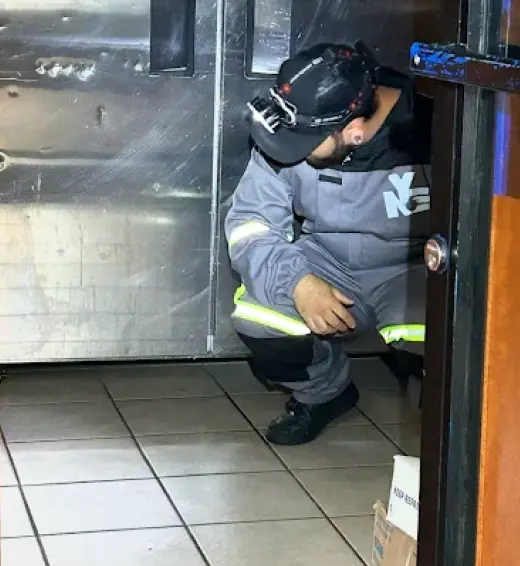
- Flashlight or headlamp — your primary tool. A bright, focused beam reveals droppings, live insects, rub marks, and damage inside dark voids.
- Moisture meter — detects elevated moisture behind walls and under floors before damage is visible. Critical for termites, carpenter ants, and moisture pests.
- Flushing agent (pyrethrin aerosol) — a fast-acting excitant that drives hidden insects, especially cockroaches, out of harborage so you can confirm presence and locate the nest. A puff of compressed air can flush non-chemically.
- Telescoping inspection mirror — sees behind and under appliances and equipment without moving them.
- Probe, awl, or screwdriver — sounds and probes wood for termite galleries and decay; a hollow sound or soft wood is a red flag.
- Hand lens (10x–15x) — reveals the morphological features that separate look-alike species (bed bug vs. bat bug, one-node vs. two-node ants).
- Ladder, collection vials, forceps, insect net — access and specimen capture for confirmation or lab ID.
- UV/black light — rodent urine fluoresces, mapping runways and contamination.
- Thermometer, hygrometer, thermal (infrared) camera — locate moisture and hidden activity.
Reading the evidence: what pests leave behind
You rarely catch the pest in the act. You read its signs.
Droppings and frass
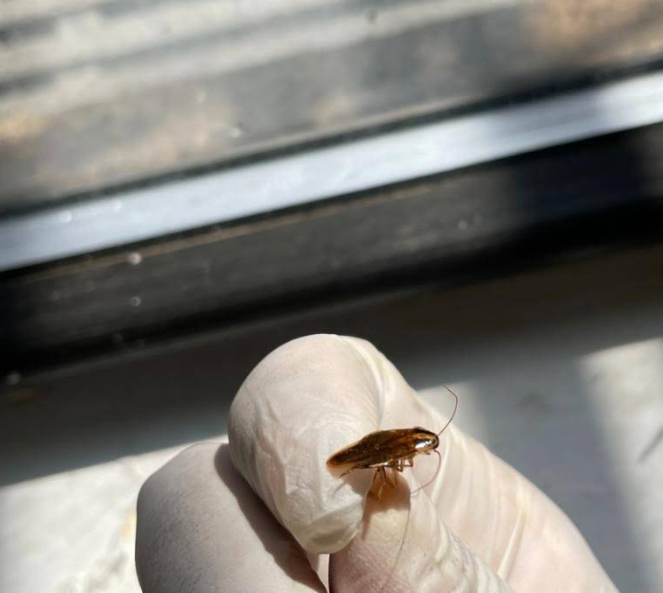
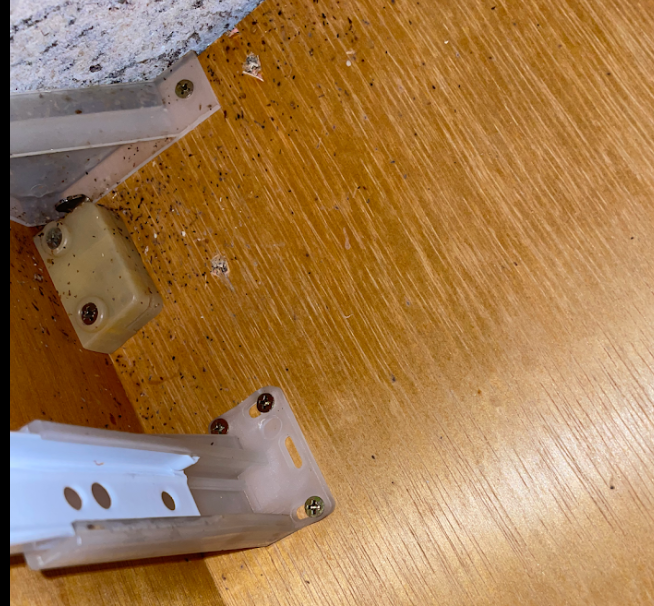
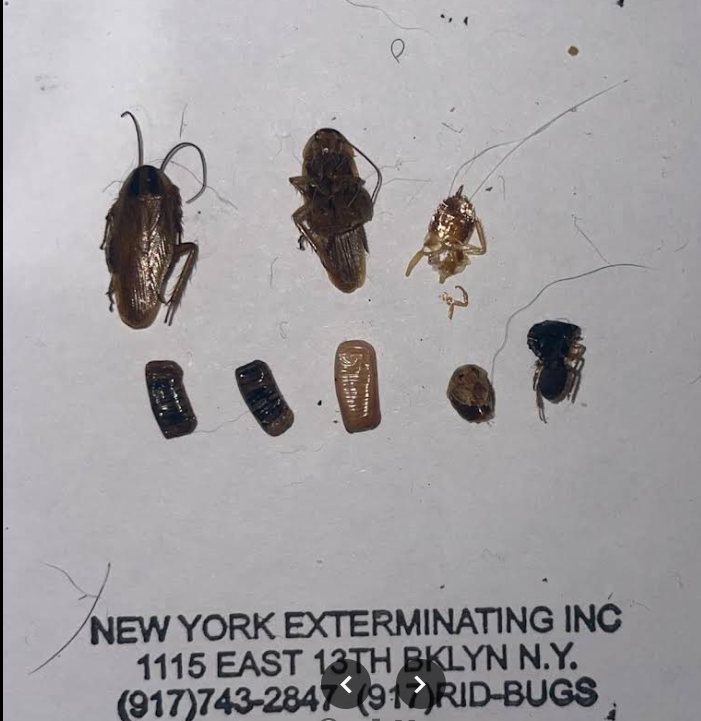
Cockroach droppings range from pepper-like specks (German) to ridged, blunt-ended pellets (American). Mouse droppings are rice-grained with pointed ends; rat droppings are capsule-shaped. Frass — insect excrement or wood residue — is diagnostic: drywood termites push out hard, six-sided pellets; powderpost beetles leave flour-fine powder; carpenter ants leave a sawdust-like mix of shavings and insect parts. That last distinction matters on the exam and in the field: carpenter ants excavate wood, they do not eat it; termites eat it.
Egg cases (oothecae)
Cockroach egg cases are species-diagnostic. The German cockroach is the only common roach whose female carries the ootheca until it is nearly ready to hatch. American oothecae are dark and glued in place; brown-banded oothecae are small, tan, and glued high on walls and furniture.
Shed skins, rub marks, gnaw marks, and mud tubes
Cast skins (exuviae) confirm an active, molting population. Rodent rub marks are dark grease smears along runways. Mouse gnaw holes have clean edges; rat gnawing is rough and torn. Pencil-width mud tubes on a foundation mean subterranean termites. Cast swarmer wings near a window point to termites or ants.
“Anyone can spray. The skill is in the inspection. If you read the droppings, the frass, the egg cases, and the moisture correctly, the pest tells you exactly what it is and where it lives before you ever open a product. Identification isn’t a formality — it’s the whole job.”
— Jorge Bedoya, Associate Certified Entomologist (ACE), New York Exterminating
Conducive conditions: why the pest is here at all
Pests need food, water, harborage, and access. Inspecting for conducive conditions is how you find and fix the root cause instead of chasing symptoms:
- Moisture — leaks, condensation, poor drainage, sweating pipes, clogged gutters. Drives termites, carpenter ants, roaches, silverfish, springtails, and drain flies.
- Poor sanitation and food — grease, spilled product, unsealed food, dirty drains (biofilm feeds drain flies), pet food, garbage.
- Harborage and clutter — cardboard, paper, dense storage against walls, voids.
- Structural gaps — cracks, unsealed penetrations, unscreened vents, worn door sweeps.
- Exterior conditions — vegetation bridging to the structure, mulch and firewood against the foundation, poor grading.
Identification: from taxonomy to a treatment decision
The classification hierarchy
Professionals think in a taxonomic ladder: Kingdom → Phylum (Arthropoda) → Class (Insecta, or Arachnida for mites, ticks, and spiders) → Order → Family → Genus → species. Insects have three body regions, three pairs of legs, one pair of antennae; arachnids have two body regions, four pairs of legs, and no antennae. Species are written in binomial form — Genus species, italicized.
Morphology and dichotomous keys
Identification comes down to comparing structures: antennae, mouthparts (chewing vs. piercing-sucking vs. sponging), wing venation, tarsal segments, pronotal markings, and — for ants — the number of petiole nodes. A dichotomous key walks you through paired either/or choices to an identity. The classic exam contrast: an ant swarmer has elbowed antennae, a pinched waist, and unequal wings; a termite swarmer has straight antennae, a broad waist, and four equal wings.
Metamorphosis drives the strategy
Whether a pest goes through complete metamorphosis (egg → larva → pupa → adult: beetles, flies, moths, ants, fleas) or incomplete/gradual metamorphosis (egg → nymph → adult: cockroaches, bed bugs, termites, silverfish) tells you which life stage does the damage and which stage your control must reach. Carpet beetle and clothes-moth larvae — not the adults — destroy fabric; bed-bug nymphs and adults both feed.
Documenting and communicating findings
An inspection that isn’t communicated is wasted. You record what you found, where, the conducive conditions, and your recommendations, and you translate that into plain language for the client. Part of that conversation is the pest threshold — the level at which action is warranted. Thresholds come in three flavors: an action threshold (the pest level that triggers control), an economic threshold (where the cost of damage justifies the cost of control), and an aesthetic threshold (tolerance based on appearance, often near zero in restaurants, hospitals, and food plants). Seeing one insect does not automatically mean treating.
A Brooklyn-based, NYSDEC-registered company (Reg. #15140) led by Jorge Bedoya, an Associate Certified Entomologist (ACE). For pests in your home or building, NYE provides IPM-based, low-exposure control matched to the exact pest and verified with a follow-up. ACE-led work comes with a client portal of service reports and photos, fully bilingual service, and no long-term contract.
Inspection & identification FAQ
What is the difference between inspection and monitoring?
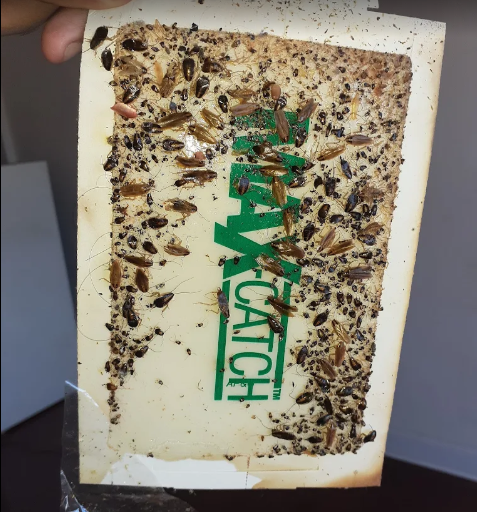
Inspection is a one-time, thorough examination that establishes what is happening right now. Monitoring is the ongoing, repeated collection of data over time using devices such as sticky traps and light traps. Inspection is the snapshot; monitoring is the movie.
Why is identification 45% of the ACE exam?
Because it is the foundation everything else rests on. If you cannot identify the pest, you cannot know its biology, choose the right control, or judge whether treatment worked. The exam weights it heavily because a professional who cannot identify pests cannot practice real IPM.
What tools should every inspector carry?
At minimum: a bright flashlight or headlamp, a moisture meter, a flushing agent, an inspection mirror, a probe, a hand lens, collection vials, and a ladder. The flashlight, moisture meter, and flushing agent are specifically emphasized in the ACE exam outline.
How do I tell carpenter ant damage from termite damage?
Carpenter ants excavate smooth, clean galleries and push out a sawdust-like frass containing insect parts; they do not eat wood. Termites consume the wood, leave soil or mud in galleries (subterranean) or hard pellets (drywood), and build mud tubes. The frass and the galleries tell the story.
What are conducive conditions?
They are the environmental factors — moisture, food, harborage, clutter, and structural gaps — that allow a pest to survive and thrive. Identifying and correcting them is what separates lasting IPM from repeat spraying.
Keep learning: continue with the other three ACE domains — Monitoring in IPM, Selection & Implementation of Control Methods, and Evaluation in IPM — or return to the full guide to becoming an ACE. Written by Jorge Bedoya, ACE.