Straight answers from a licensed New York exterminator and Associate Certified Entomologist (ACE) — serving all five boroughs, in English and Spanish.
Get a Free Estimate →⏱ 5 min read
Quick answer: Tiny white or translucent bugs in a NYC apartment are almost always one of a few harmless, moisture-loving species: springtails (Collembola), booklice / psocids (Psocoptera), mold and grain mites (Tyrophagus), dust mites (Dermatophagoides), or clothes-moth larvae (Tineola bisselliella). None of them bite or spread disease. What they almost always have in common is moisture — which, in an old NYC building with steam heat and damp bathrooms, is the real thing to fix.
“There are tiny white specks moving on my counter / windowsill / bathroom wall” is one of the most common panic photos an Associate Certified Entomologist (ACE) gets. The reassuring news: in a New York City apartment these are nearly always harmless. The useful news: each one points to a specific condition in your unit. Here is how to tell them apart and what each is really telling you.
The common NYC “tiny white bugs,” by where you find them
| What you see | Likely species | Where in NYC | What it signals |
|---|---|---|---|
| Tiny specks that jump when disturbed | Springtails (Collembola) | Damp bathrooms, sink edges, potted-plant soil, basements | Excess moisture / overwatered plants |
| Slow, pale specks on books, walls, food packaging | Booklice / psocids (Psocoptera) | Humid closets, old paper, behind wallpaper | Humidity + surface mold they graze on |
| Near-microscopic “dust” that moves, often near stored food | Mold & grain mites (Tyrophagus) | Damp pantries, old flour/grain, cheese | Spoiled or damp stored food |
| Invisible to the eye; only allergy symptoms | Dust mites (Dermatophagoides) | Bedding, upholstery, carpet | An asthma/allergy concern, not a sighting |
| Small white “worms” + holes in wool/silk | Clothes-moth larvae (Tineola bisselliella) | Closets, stored wool, rugs | Textile pest activity |
Springtails (Collembola) — the jumpers
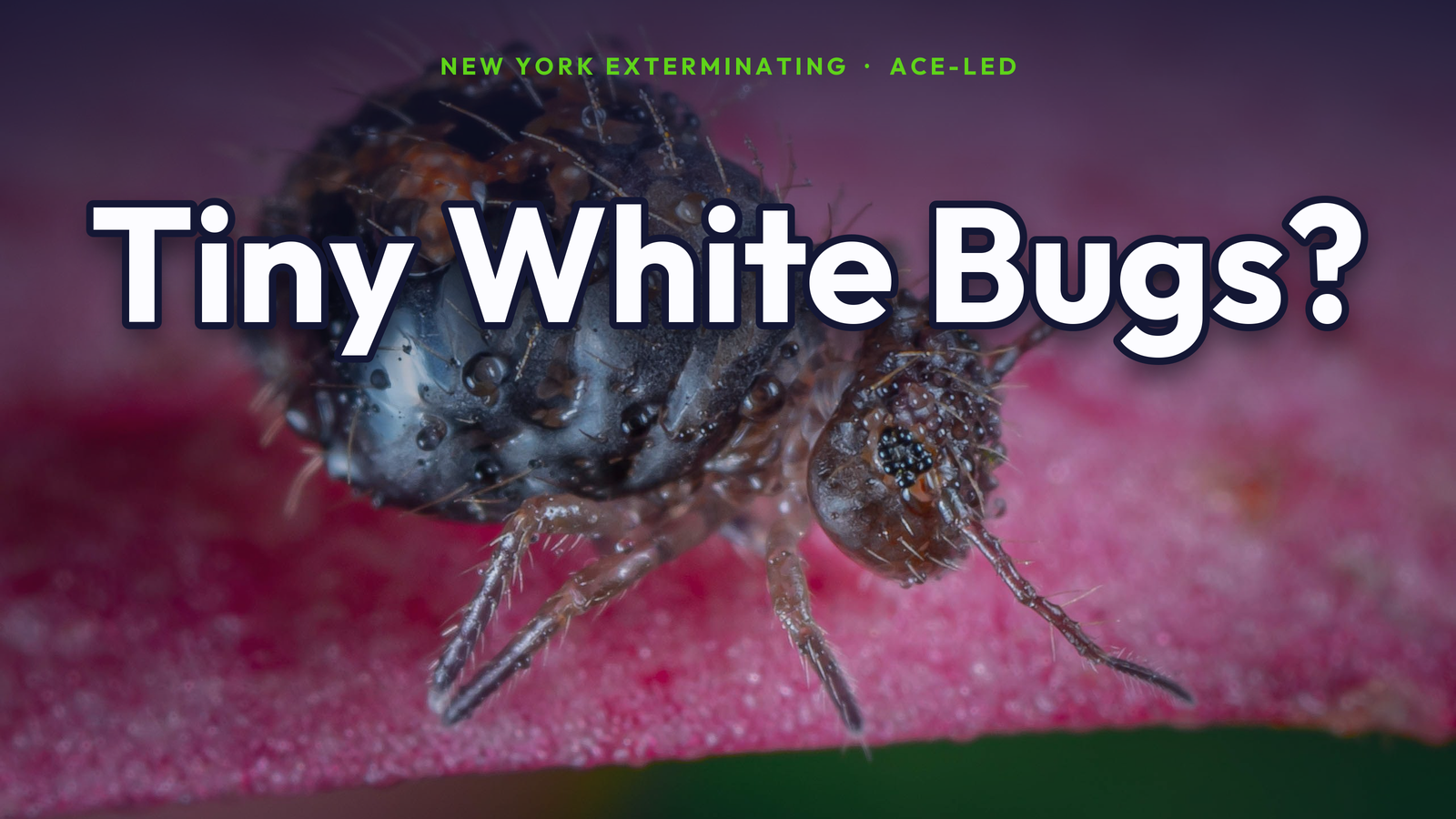
If the specks spring away when you touch them, they are springtails — named for a tail-like appendage (the furcula) they snap to leap. They are not insects in the strict modern sense and are completely harmless: no bites, no disease, no damage. They live wherever there is dampness and they feed on mold and decaying organic matter, so in NYC they cluster around tubs, sink cabinets, and the soil of overwatered houseplants. The fix is moisture, not pesticide: dry the area, fix drips, let plant soil dry between waterings, and run the bathroom fan.
Booklice / psocids (Psocoptera) — the paper grazers
Pale, soft, 1–2 mm, slow-moving, often on old books, paper, cardboard, or damp walls. Despite the name they are not true lice and do not bite. They graze on microscopic mold, so their presence is really a humidity flag — common in NYC closets, behind bookshelves on exterior walls, and in long-stored boxes. Lower the humidity and the mold (and the psocids) recede. NYE handles persistent cases with targeted booklice and psocid control.
Mold & grain mites (Tyrophagus) — the pantry “dust”
So small they look like moving powder, grain and mold mites turn up on damp or old stored food (flour, grain, cheese, pet food) and in humid pantries. They do not bite, but heavy infestations spoil food and a few people develop skin irritation from handling infested products. Discard affected food in a sealed bag, dry and clean the pantry, and store dry goods in hard containers — the same playbook as pantry pest control.
Dust mites (Dermatophagoides) — the ones you never see
Dust mites are microscopic and live in bedding, upholstery, and carpet, feeding on shed skin flakes. You will never “spot” one — they matter because their droppings are a recognized indoor allergen and asthma trigger, a real concern in dense NYC housing. Control is about humidity and laundering: wash bedding hot, reduce humidity below ~50%, and use allergen-proof encasements.
Clothes-moth larvae (Tineola bisselliella)
If the “tiny white bugs” are small cream-colored larvae near wool sweaters, rugs, or silk — with irregular holes in the fabric — these are clothes-moth larvae, a true textile pest. This is the one on the list that causes real damage. Clean and isolate affected textiles and address the source promptly.
How to tell a harmless white bug from something that bites
None of the species above bite. If you are getting bites with no clearly visible insect, that is a different investigation — usually bird or rodent mites, carpet beetles, or a skin reaction, which we cover in phantom bug bites in your NYC apartment and the bed bug bites differential. And if a pale speck near the bed turns out to be a young insect rather than a mite, see whether it could be a look-alike before assuming the worst.
A Brooklyn-based, NYSDEC-registered company (Reg. #15140) led by Jorge Bedoya, an Associate Certified Entomologist (ACE). For pests in your home or building, NYE provides IPM-based, low-exposure control matched to the exact pest and verified with a follow-up. ACE-led work comes with a client portal of service reports and photos, fully bilingual service, and no long-term contract.
Tiny White Bugs FAQ
Do tiny white bugs bite?
The common ones in NYC apartments — springtails, booklice, grain and mold mites, dust mites, and clothes-moth larvae — do not bite people or spread disease. If you are getting bites with no visible insect, the cause is usually bird or rodent mites or a skin reaction, not these.
Why do I suddenly have tiny white bugs in my bathroom or kitchen?
Almost always moisture. Springtails, booklice, and mold mites all depend on damp conditions and the microscopic mold that grows there. In NYC’s old buildings, steam heat, poor ventilation, and damp cabinets create exactly that. Drying the area and improving ventilation usually clears them.
Are the tiny white bugs in my plant soil harmful?
Those are usually springtails feeding on damp soil and organic matter — harmless to you and to the plant. Let the soil dry more between waterings and they typically disappear.
What are the tiny white things in my flour or pantry?
Likely grain or mold mites, which appear as moving “dust” on damp or old stored food. Discard affected items in a sealed bag, dry and clean the space, and store dry goods in airtight containers.
How do I get rid of them for good?
Control the moisture and the food source and most tiny white bugs leave on their own — they are a symptom. If they persist after you have dried things out, an Associate Certified Entomologist can identify the exact species and find the moisture or mold source driving them.
Not sure what the tiny white bugs are? Send it to an Associate Certified Entomologist for a positive ID. New York Exterminating serves all five boroughs, no contracts. Call (347) 210-4646 or request service online.
Reviewed by Jorge Bedoya, Associate Certified Entomologist (ACE), New York Exterminating. For persistent allergy or asthma symptoms, consult a physician.