Straight answers from a licensed New York exterminator and Associate Certified Entomologist (ACE) — serving all five boroughs, in English and Spanish.
Get a Free Estimate →⏱ 6 min read
Termite eggs are tiny (about 1 mm), oval, and translucent white to cream — laid in clusters by the queen deep inside the colony’s sealed nest (underground, for the subterranean termites found in the NYC area). Because of that, homeowners almost never see termite eggs. If you’ve found “eggs” out in the open, they’re far more likely ant eggs, larvae, or debris. The warning signs you will actually see are swarmers and discarded wings, mud tubes, and frass (wood damage).
Searching for termite eggs usually means you’re worried about termites — which is smart, because termite damage is expensive and easy to miss. This guide explains what the eggs look like, why you won’t find them, and the signs that actually matter. Written and reviewed by Jorge Bedoya, an Associate Certified Entomologist (ACE).
What termite eggs look like
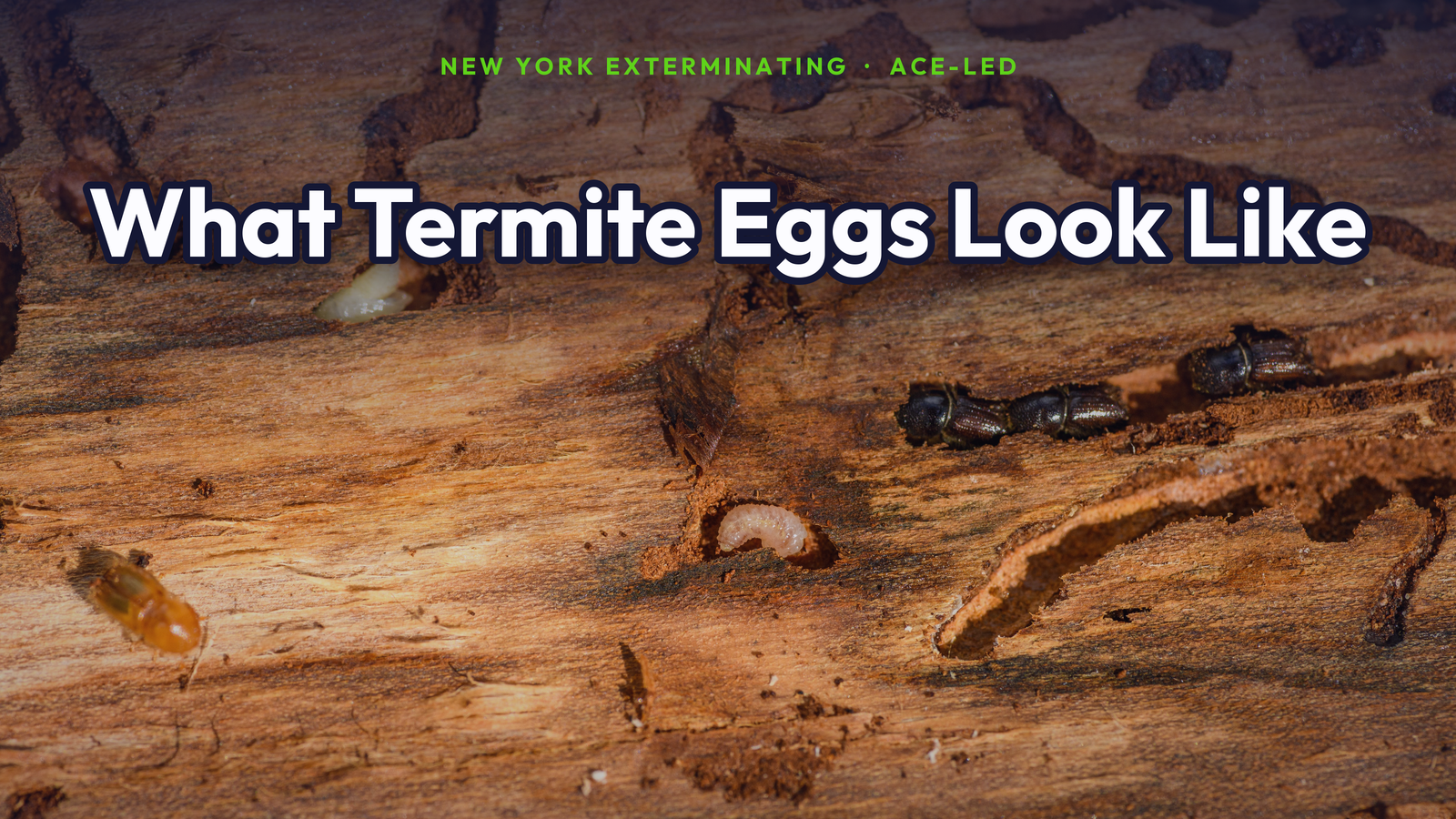
A termite egg is about a millimeter long, oval or kidney-shaped, and translucent white to pale cream. The queen lays them in clusters, and they’re tended by workers deep in the nest. They look broadly similar to ant eggs — which is part of why people confuse the two — but you would essentially never encounter them loose in your home.
Why you won’t see termite eggs
The eastern subterranean termites that occur in the New York region nest underground or deep within infested wood, in sealed chambers that workers maintain. The eggs, the queen, and the pale workers stay hidden; they’re only exposed if you physically break open a nest, a mud tube, or heavily infested wood. So finding termite eggs lying around is not how termite problems are discovered — the colony keeps them out of sight.
What people mistake for termite eggs
- Ant eggs and larvae — the most common mix-up; also small, pale, and oval, but found with ants.
- Frass (termite droppings) — drywood-termite frass looks like tiny tan pellets/sawdust, not eggs (drywood termites are uncommon in NY but seen in imported furniture).
- Other insect eggs or debris — spider egg sacs, fungus, or food crumbs.
The termite signs you WILL see
Instead of eggs, watch for the evidence a colony actually leaves:
- Swarmers and discarded wings. In spring, winged reproductive termites emerge to start new colonies. Piles of small, equal-length discarded wings on windowsills or floors are a classic red flag.
- Mud tubes. Subterranean termites build pencil-width mud shelter tubes up foundations, walls, and crawl spaces to travel between soil and wood.
- Damaged or hollow-sounding wood. Wood that sounds hollow when tapped, blistered paint, or galleries packed with soil.
Any one of these warrants a professional inspection — long before you’d ever find an egg.
What to do if you suspect termites
Don’t wait to find eggs — you won’t. If you’ve seen swarmers, wings, or mud tubes, or you’re buying or selling a property, get a professional termite inspection and treatment. For real-estate transactions, we also provide a WDO inspection and termite letter. Early detection is the difference between a routine treatment and major structural repair.
A Brooklyn-based, NYSDEC-registered company (Reg. #15140) led by Jorge Bedoya, an Associate Certified Entomologist (ACE). For termites, NYE provides termite inspection and targeted treatment with documented findings. ACE-led work comes with a client portal of service reports and photos, fully bilingual service, and no long-term contract.
Termite egg FAQ
What do termite eggs look like?
They are tiny (about 1 mm), oval, and translucent white to cream, laid in clusters — similar in appearance to ant eggs.
Can you see termite eggs?
Almost never. They’re kept deep in the sealed nest by workers, so homeowners don’t encounter them unless a nest or infested wood is broken open.
Where are termite eggs laid?
The queen lays them in protected chambers inside the colony — underground for the subterranean termites found in the NYC region, or within infested wood.
I found tiny white eggs — are they termites?
Most likely not. Loose, visible eggs are far more often ant eggs or other debris. Termite eggs stay hidden in the nest.
What are the real signs of termites?
Swarmers and piles of discarded wings, pencil-width mud tubes on foundations and walls, and hollow-sounding or damaged wood.
Are there termites in NYC?
Yes — eastern subterranean termites occur in the New York region. They’re less common than in the South but do cause damage, which is why inspections matter, especially in real-estate deals.
Get an ACE-led termite inspection. Request one here or call (347) 210-4646.
About the author: Written and reviewed by Jorge Bedoya, an Associate Certified Entomologist (ACE) at New York Exterminating.
Why New Yorkers choose NYE
Led by an ACE
Every job is overseen by Jorge Bedoya, an Associate Certified Entomologist (ESA) — not a call center.
No contracts
One thorough treatment with an optional 50%-off verification visit. No auto-renewal, no lock-in.
Elimination, not spraying
Resistance-aware methods — including our signature microinjection — that target the source, with documentation.
Licensed & local
NYSDEC Reg. #15140, serving all five boroughs since 2010. Fully bilingual (EN/ES).
Backed by science, not guesswork. Your treatment is led by Jorge Bedoya, an Associate Certified Entomologist (ACE) credentialed by the Entomological Society of America — correct pest ID, resistance-aware products, and a documented plan.
What happens after you call
- Fast response. Call (347) 210-4646 — same-day appointments are often available, including after-hours emergencies.
- Inspection & ID. We confirm the pest and find the source, not just where you saw it.
- Targeted treatment. A resistance-aware plan matched to the pest, explained before we start.
- Verification & prevention. Optional follow-up to confirm zero activity, plus reports and photos in your client portal.