Straight answers from a licensed New York exterminator and Associate Certified Entomologist (ACE) — serving all five boroughs, in English and Spanish.
Get a Free Estimate →⏱ 5 min read
Brooklyn, NY / Sao Paulo, Brazil — September 2026. Jorge Bedoya, Associate Certified Entomologist (ACE) and co-founder of New York Exterminating, took the main stage at ExpoPrag 2026 — the 30th-anniversary edition of Latin America’s largest urban pest-control congress, organized by APRAG at the Centro de Convencoes Frei Caneca in Sao Paulo — to present the Trio Protocol, the method New York Exterminating uses to eliminate German cockroach (Blattella germanica) infestations in a single service.

The lecture — framed around the mistakes that make cockroach control fail — drew a full room. Attendees stood and raised their phones to photograph the data slides, and Bedoya left the congress having made a wide range of new professional connections across the Americas, including early conversations with leaders of several regional pest-management associations about speaking at future events.
Why most German cockroach treatments fail
Bedoya opened with the uncomfortable truth behind repeat infestations: most German cockroach populations in dense cities are resistant to pyrethroids, the insecticide class most sprays still rely on. Spraying a resistant population thins the visible insects for a few days, selects for the survivors, and leaves the colony — and its egg cases — intact. The result is the monthly-spray treadmill that never actually ends the infestation.
“You cannot spray your way out of a resistant population. If the protocol does not account for resistance and for the egg case, you are managing the problem, not solving it.” — Jorge Bedoya, ACE

How the Trio Protocol ends the infestation in one service
The Trio Protocol is built to collapse the population from a single technician visit and keep working over the following weeks:
- Stage 1 — flush and knockdown (Pyrocide 100). A pyrethrin flush drives the colony out of harborages so it can be treated directly. More than 80 percent of the population is reduced across the opening stages.
- Stage 2 — residual and gel. A non-pyrethroid residual plus targeted gel bait keeps eliminating survivors after the technician leaves — no monthly return required.
- Stage 3 — the reproductive shutdown (Tekko Trio IGR). The step most treatments skip. This insect growth regulator attacks reproduction itself: it reduces egg and embryo viability, so survivors cannot repopulate. New nymphs never hatch, and the population keeps falling.
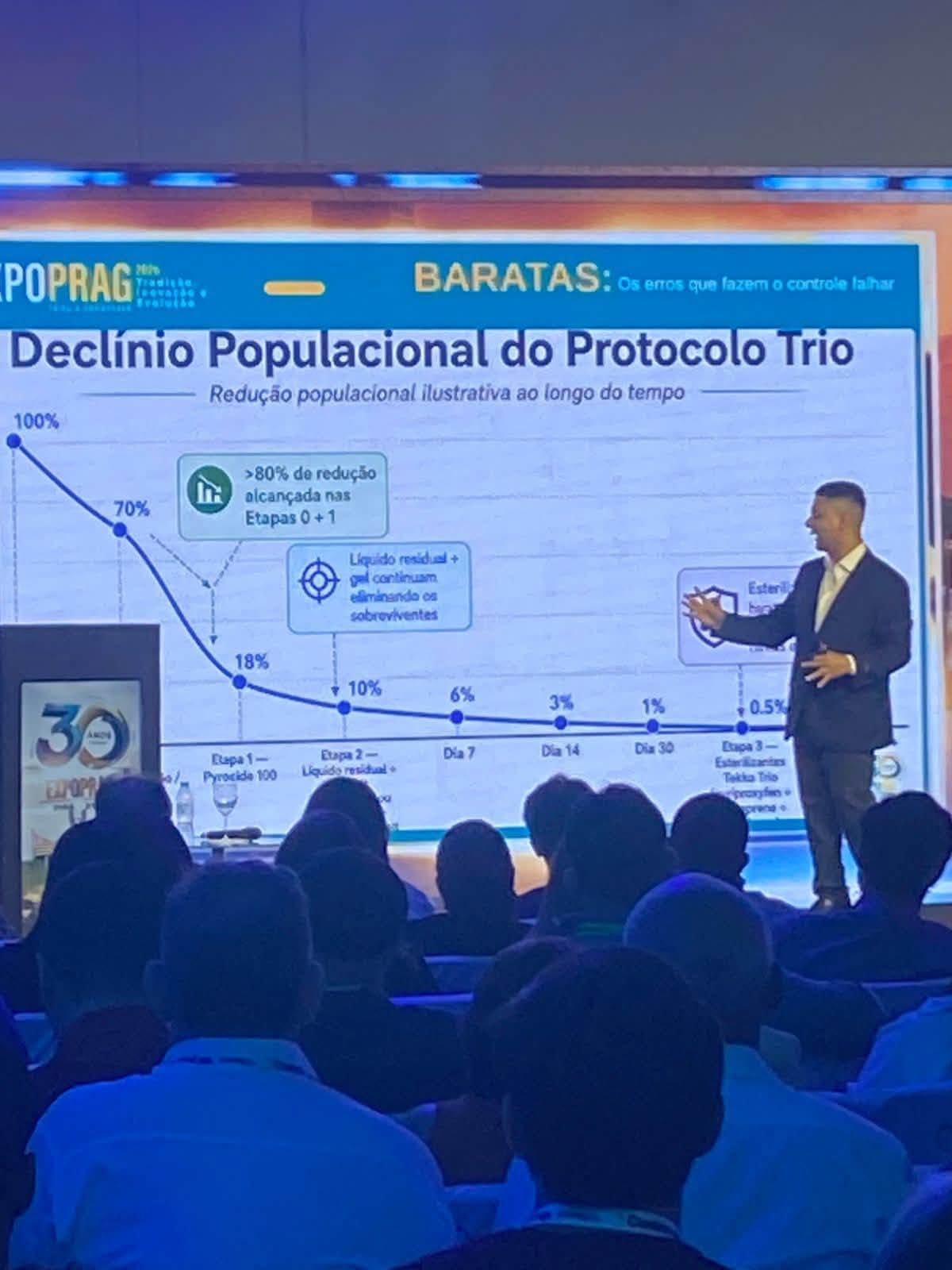
On the slide the audience photographed, Bedoya showed the population curve his teams see in the field: 100% → 70% → 18% → 10% (day 7) → 6% (day 14) → 3% → 1% (day 30) → 0.5% — a near-total collapse driven by a single service, with the residual and IGR continuing the work over the following month.
Why the IGR step matters most
The reason pyrethroid-only programs relapse is the egg case (ootheca), which shields developing embryos from contact sprays. By adding an IGR that compromises embryo viability, the Trio Protocol closes the reproductive loop the sprays leave open. That, Bedoya argued, is the difference between a treatment that reduces cockroaches and one that eliminates the infestation.

New York Exterminating is based in Midwood, Brooklyn (NYSDEC license #15140) and serves all five boroughs plus Nassau and Westchester, ACE-led and bilingual in English and Spanish, with a callback rate under 1 percent on Trio Protocol jobs. Learn more on the Trio Protocol page or the German cockroach guide.
A Brooklyn-based, NYSDEC-registered company (Reg. #15140) led by Jorge Bedoya, an Associate Certified Entomologist (ACE). For bed bugs, NYE provides discreet bed bug treatment (heat and targeted options) verified with a follow-up visit. ACE-led work comes with a client portal of service reports and photos, fully bilingual service, and no long-term contract.
Frequently asked questions
What is the Trio Protocol?
The Trio Protocol is New York Exterminating’s three-stage method for eliminating German cockroaches in a single service: a pyrethrin flush and knockdown, a non-pyrethroid residual plus gel bait, and an insect growth regulator (IGR) that reduces egg and embryo viability so the population cannot rebuild.
Why do German cockroach sprays stop working?
Most urban German cockroach populations are resistant to pyrethroids, the class most sprays use. Spraying kills the visible insects but selects for resistant survivors and leaves the egg cases intact, so the infestation returns.
What did Jorge Bedoya present at ExpoPrag 2026?
Jorge Bedoya, ACE, co-founder of New York Exterminating, presented the Trio Protocol for single-visit German cockroach elimination at ExpoPrag 2026 in Sao Paulo, explaining why pyrethroids fail against resistant populations and how IGRs shut down cockroach reproduction.