Straight answers from a licensed New York exterminator and Associate Certified Entomologist (ACE) — serving all five boroughs, in English and Spanish.
Get a Free Estimate →⏱ 5 min read
A mouse is small (2–4″ body) with large ears, a pointed snout, and a thin tail as long as its body; a rat is much bigger and heavier (7–10″ body) with small ears, a blunt snout, and a thick, scaly tail. In NYC the rat you’ll almost always meet is the Norway rat, which burrows and lives in basements, sewers, and yards; mice nest inside walls and cabinets. The other quick tells are dropping size (rice vs. raisin) and behavior — mice are curious, rats are wary.
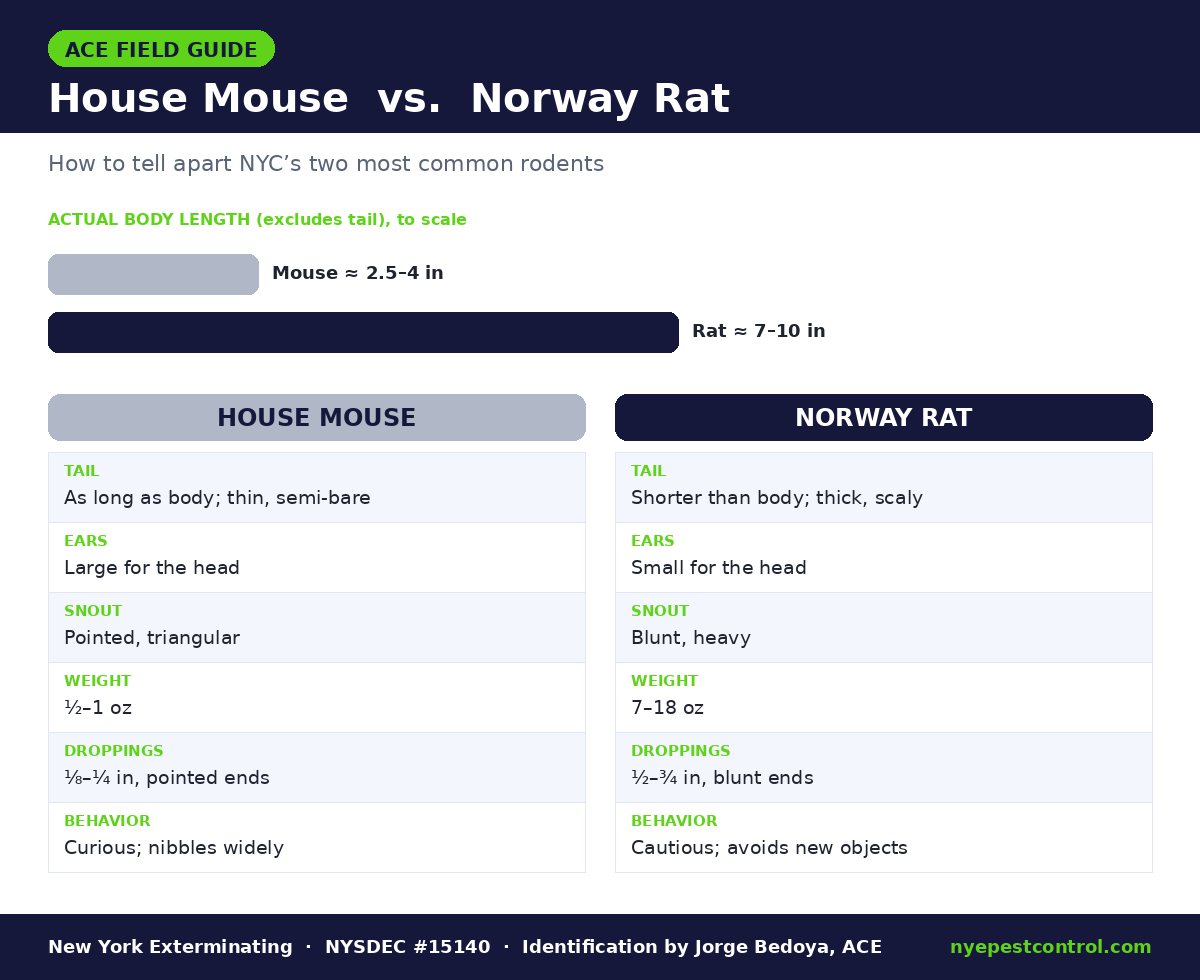
Knowing whether you have rats or mice changes how the problem gets solved — they behave differently and respond to different strategies. Here’s how to tell them apart. Written and reviewed by Jorge Bedoya, an Associate Certified Entomologist (ACE).
| Feature | Mouse | Rat (Norway) |
|---|---|---|
| Body size | 2–4″, ~½–1 oz | 7–10″, up to ~1 lb |
| Ears | Large for the head | Small |
| Snout | Pointed | Blunt |
| Tail | Thin, as long as body | Thick, scaly, shorter than body |
| Droppings | Rice-sized, pointed | Raisin-sized, blunt |
| Where | Walls, cabinets, drawers | Basements, burrows, sewers, yards |
Behavior: the difference that matters for control
Mice are curious — they investigate new objects, so they’re relatively quick to trap. Norway rats are neophobic: they’re wary of anything new in their environment and will avoid fresh traps and bait stations for days. That’s why DIY rat trapping so often fails, and why a professional approach uses pre-baiting, correct placement, and exclusion rather than just setting a few traps.
Which one is more common in NYC?
The Norway rat dominates New York City — it burrows along foundations, embankments, and parks and travels through the sewer system. Mice are extremely common indoors, especially in apartments, where they nest in wall voids and behind cabinets. Many NYC buildings deal with both. See where rats are heaviest in our rattiest-neighborhoods data study, and learn to read the evidence in our droppings identification guide.
Getting rid of either one
Whether it’s rats or mice, baiting alone won’t hold — the key is sealing entry points with rodent-proof metal exclusion so they can’t get back in, paired with strategic trapping. Our ACE-led rodent control & exclusion program does exactly that, matched to the species and the building.
Related: confirmed it is a rat? Here is how to get rid of rats in NYC.
A Brooklyn-based, NYSDEC-registered company (Reg. #15140) led by Jorge Bedoya, an Associate Certified Entomologist (ACE). For mice and rats, NYE provides rodent exclusion that seals the entry points, not just trapping. ACE-led work comes with a client portal of service reports and photos, fully bilingual service, and no long-term contract.
Rat vs. mouse FAQ
How can I tell if I have rats or mice?
Size is the fastest tell: mice are small with large ears and a thin tail; rats are much bigger with small ears, a blunt snout, and a thick tail. Dropping size confirms it — rice-sized for mice, raisin-sized for rats.
Are there rats or mice in NYC apartments?
Both. Norway rats dominate outdoors and in basements; mice are very common inside apartments, nesting in walls and cabinets.
Why are rats harder to get rid of than mice?
Rats are neophobic — wary of new objects — so they avoid fresh traps and bait for days. Effective control uses pre-baiting, correct placement, and exclusion.
Can mice turn into rats?
No — they’re different species. A small rodent is not a baby rat by default; check ears, snout, tail, and dropping size to identify it.
What’s the most important step to stop either one?
Sealing entry points with metal exclusion. Without that, trapping or baiting only removes the current animals while new ones keep entering.
An ACE will identify it and seal them out. Get a free estimate or call (347) 210-4646.
About the author: Written and reviewed by Jorge Bedoya, an Associate Certified Entomologist (ACE) at New York Exterminating.
Why New Yorkers choose NYE
Led by an ACE
Every job is overseen by Jorge Bedoya, an Associate Certified Entomologist (ESA) — not a call center.
No contracts
One thorough treatment with an optional 50%-off verification visit. No auto-renewal, no lock-in.
Elimination, not spraying
Resistance-aware methods — including our signature microinjection — that target the source, with documentation.
Licensed & local
NYSDEC Reg. #15140, serving all five boroughs since 2010. Fully bilingual (EN/ES).
Backed by science, not guesswork. Your treatment is led by Jorge Bedoya, an Associate Certified Entomologist (ACE) credentialed by the Entomological Society of America — correct pest ID, resistance-aware products, and a documented plan.
What happens after you call
- Fast response. Call (347) 210-4646 — same-day appointments are often available, including after-hours emergencies.
- Inspection & ID. We confirm the pest and find the source, not just where you saw it.
- Targeted treatment. A resistance-aware plan matched to the pest, explained before we start.
- Verification & prevention. Optional follow-up to confirm zero activity, plus reports and photos in your client portal.