Straight answers from a licensed New York exterminator and Associate Certified Entomologist (ACE) — serving all five boroughs, in English and Spanish.
Get a Free Estimate →⏱ 7 min read
Tiny bugs in your bed or bedroom are most often bed bugs, carpet beetles, fleas, booklice, baby cockroaches, or (rarely felt) dust mites. The fastest way to narrow it down: does it bite, does it jump, what shape is it, and where exactly is it? A flat reddish-brown oval in the mattress seams points to bed bugs; a fuzzy or patterned bug near fabric points to carpet beetles; a jumper around the ankles points to fleas. Use the quick guide below, or our free identifier tool, to figure out which.
Finding small bugs in your bed is unsettling — but “tiny bug” could mean several very different insects, each needing a different response. This guide walks through the usual suspects, what each looks like, and exactly where to look. Written and reviewed by Jorge Bedoya, an Associate Certified Entomologist (ACE).
Our free tool asks a few questions and points you to the likely culprit.
Start here: four questions
- Does it bite you at night? Bed bugs and fleas bite; carpet beetles, booklice, and baby roaches don’t.
- Does it jump? Fleas jump. Bed bugs can’t jump or fly.
- What shape is it? Flat oval = bed bug; patterned/fuzzy = carpet beetle; long with long antennae = baby roach; round and shiny = spider beetle.
- Where exactly is it? In the mattress seams = bed bug; near rugs/closets = carpet beetle; damp corners and books = booklice; kitchen/bathroom = baby roach.
The usual suspects in an NYC bedroom
Bed bugs (and their nymphs)
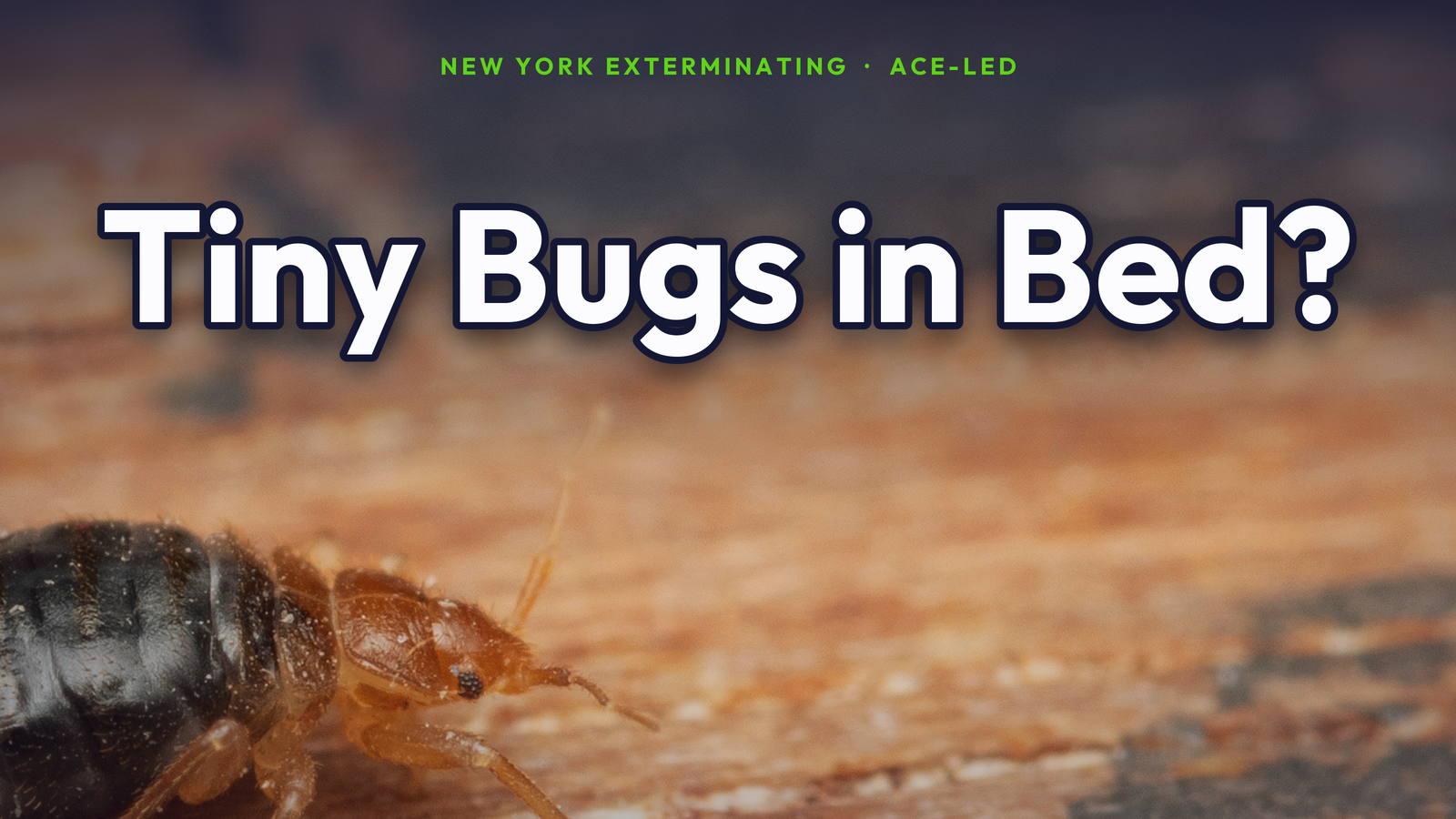
Flat, oval, reddish-brown, apple-seed sized; young ones are translucent. They hide in mattress seams, the box spring, and the headboard, and bite at night. This is the one you most want to rule in or out. See what baby bed bugs look like and what bed bug eggs look like.
Carpet beetles
Small, rounded, with a patterned black-white-orange shell; larvae are fuzzy and bristly. Found near rugs, closets, and wool/fabric. They don’t bite, but larval hairs can irritate skin and get mistaken for bites.
Fleas
Dark, jump, and bite around the ankles. Usually a pet is involved. Bed bugs can’t jump, so a jumper points to fleas.
Booklice
Very tiny, pale, soft-bodied insects in humid spots near books, wallpaper, and bathrooms. Harmless and non-biting — a sign of dampness more than a pest problem.
Baby cockroaches
Long, cylindrical, fast, with antennae nearly as long as the body. More common in kitchens and bathrooms but can wander. See the baby cockroach guide.
Dust mites (you won’t see them)
Microscopic and not visible to the naked eye. If you feel itchy but never see a bug, dust mites or a non-pest skin reaction may be involved — see mystery bites explained.
What about “grey” or “little brown” bugs in the bed?
Color alone is a weak clue because lighting and feeding change it — an unfed bed bug looks pale tan, a fed one looks dark red-brown, and booklice look grey. Rely on shape, movement, bites, and location instead. When in doubt, capture the bug on clear tape or in a small container and photograph it against something for scale.
How to confirm and what to do next
If anything suggests bed bugs — bites in a line, flat ovals in the seams, tiny dark spots on the sheets — confirm it before treating, because the wrong treatment wastes time while the problem grows. An ACE inspection (including K-9 detection for low-level cases) gives a definitive answer. See our bed bug treatment service, or run the What’s Biting Me? identifier first.
A Brooklyn-based, NYSDEC-registered company (Reg. #15140) led by Jorge Bedoya, an Associate Certified Entomologist (ACE). For bed bugs, NYE provides discreet bed bug treatment (heat and targeted options) verified with a follow-up visit. ACE-led work comes with a client portal of service reports and photos, fully bilingual service, and no long-term contract.
Tiny bugs in bed FAQ
What are the tiny bugs in my bed?
Most often bed bugs, carpet beetles, fleas, booklice, or baby cockroaches. Shape, whether it bites or jumps, and exactly where you find it are the fastest ways to tell them apart.
What are the tiny bugs that bite in bed?
Bed bugs and fleas are the common biters. Bed bugs are flat ovals that don’t jump and bite where skin is exposed; fleas jump and bite around the ankles.
I see tiny bugs but no bites — what are they?
Likely carpet beetles or booklice, which don’t bite. If you feel itching but never see a bug, dust mites or a non-pest skin reaction may be the cause.
What are tiny black or brown bugs in the bedroom?
Color is unreliable on its own. Use shape and location: flat oval near the mattress is likely a bed bug; round and shiny in the pantry is a spider beetle; fuzzy near rugs is a carpet beetle larva.
How do I know if they’re bed bugs?
Look for flat reddish-brown ovals in the mattress seams, pale shed skins, tiny white eggs in crevices, and small dark fecal spots on sheets. Confirm with a professional inspection.
Should I be worried?
Only bed bugs and fleas need active treatment of the home; carpet beetles and booklice are nuisance issues often tied to fabric or dampness. Identifying correctly tells you how concerned to be.
An ACE will tell you exactly what it is and what to do. Get a free estimate or call (347) 210-4646.
About the author: Written and reviewed by Jorge Bedoya, an Associate Certified Entomologist (ACE) at New York Exterminating.
Why New Yorkers choose NYE
Led by an ACE
Every job is overseen by Jorge Bedoya, an Associate Certified Entomologist (ESA) — not a call center.
No contracts
One thorough treatment with an optional 50%-off verification visit. No auto-renewal, no lock-in.
Elimination, not spraying
Resistance-aware methods — including our signature microinjection — that target the source, with documentation.
Licensed & local
NYSDEC Reg. #15140, serving all five boroughs since 2010. Fully bilingual (EN/ES).
Backed by science, not guesswork. Your treatment is led by Jorge Bedoya, an Associate Certified Entomologist (ACE) credentialed by the Entomological Society of America — correct pest ID, resistance-aware products, and a documented plan.
What happens after you call
- Fast response. Call (347) 210-4646 — same-day appointments are often available, including after-hours emergencies.
- Inspection & ID. We confirm the pest and find the source, not just where you saw it.
- Targeted treatment. A resistance-aware plan matched to the pest, explained before we start.
- Verification & prevention. Optional follow-up to confirm zero activity, plus reports and photos in your client portal.