Straight answers from a licensed New York exterminator and Associate Certified Entomologist (ACE) — serving all five boroughs, in English and Spanish.
Get a Free Estimate →⏱ 12 min read
A scientist explains
You didn’t do it wrong.The products did.
Why store-bought sprays, bait stations and foggers almost always fail against German cockroaches, explained from the chemistry up by an Associate Certified Entomologist.
Sprays. Then bait. Then a fogger.
Then it gets worse.

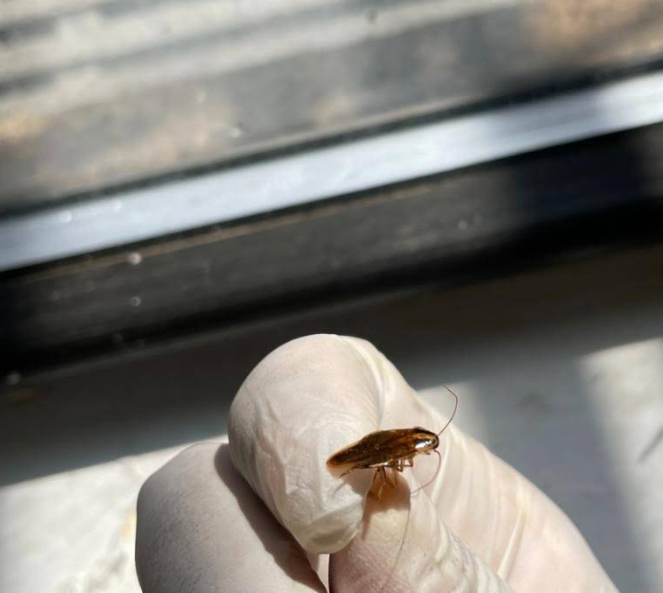
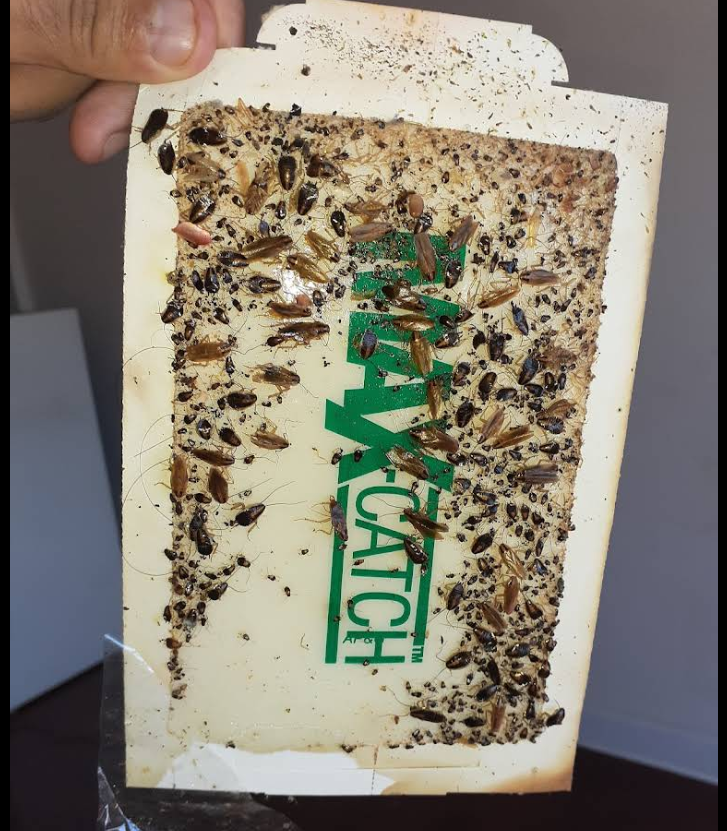
Almost every German cockroach job we take in NYC has the same history. It improved briefly, then came back harder, and often showed up in rooms that were previously clean. That isn’t bad luck and it isn’t a dirty apartment. It’s chemistry and insect behavior working exactly as you’d predict.
They’re repellent
Retail sprays are pyrethroids. Cockroaches detect them, avoid them, and scatter deeper into walls instead of dying on the surface.
They’re resistant
NYC populations have faced that exact chemical class for decades. It’s the chemistry they’ve had the most generations to adapt to.
Wrong formulation
Oil-carrier products soak into porous surfaces, taking the active ingredient below where an insect would ever contact it.
You’re treating where they aren’t.
German cockroaches spend the overwhelming majority of their lives inside protected harborages: refrigerator and stove motor housings, the cavity behind a dishwasher, microwave voids, cabinet joints, hollow door frames, gaps around plumbing. They emerge briefly at night and go back in.
Anything sprayed on a countertop, baseboard or cabinet face treats the small minority that happened to be exposed. The colony, and every egg case in it, is untouched. Each ootheca carries roughly 30 to 40 nymphs and hatches on its own schedule, which is exactly why the problem reliably returns two to three weeks after it looked solved.
Not just ineffective. Counterproductive.
Almost everything on the shelf is repellent
Consumer sprays are overwhelmingly pyrethroids (permethrin, cypermethrin, bifenthrin, deltamethrin) or natural pyrethrins. These are excito-repellent: insects detect them and actively avoid treated surfaces.
For a wasp on a porch, fine. For German cockroaches it’s actively harmful. Instead of resting on a treated surface long enough to pick up a lethal dose, they leave. They push deeper into wall voids, travel along plumbing chases, and appear in rooms or neighboring apartments that were previously clean. A contained kitchen problem becomes an apartment-wide one. And the insects that get a brief, non-lethal exposure are precisely the ones selected to survive it.
You’re allowed to buy the one class they resist most
German cockroaches are among the most resistance-prone urban pests on earth, and pyrethroid resistance in dense multi-unit housing is well documented, through both target-site mutations and enhanced metabolic breakdown by detoxifying enzymes.
So the chemistry available over the counter is broadly the chemistry city populations have adapted to hardest. Repeated sublethal exposure from DIY spraying doesn’t just fail, it applies selection pressure that makes the survivors harder to treat. More in German cockroach resistance in NYC.
The formulation is chosen for the shelf, not your kitchen
This one is invisible to consumers and it matters enormously. Many insecticide active ingredients degrade by hydrolysis in water, and it worsens in alkaline conditions. A ready-to-use product has to survive years in a warehouse and still work, so retail liquids and aerosols are commonly built on oil or petroleum-solvent carriers rather than water. That’s a stability and shelf-life decision, not a performance one.
The consequence: oil carriers penetrate porous materials. Sprayed onto unsealed wood, concrete, grout, drywall or raw cabinet interiors, the carrier wicks the active ingredient into the substrate, below the surface, where an insect walking across never contacts a meaningful dose. The product is technically applied. It’s just no longer available.
Professionals solve this by matching formulation to substrate, using water-based suspension concentrates or microencapsulated products on porous surfaces so the active stays on top as particles available for tarsal contact. You get one product and one carrier, whatever you’re spraying.
| What you buy | What actually happens |
|---|---|
| Repellent pyrethroid spray | Detected and avoided; population scatters into voids and adjacent rooms |
| Oil-carrier liquid | Absorbs into porous surfaces; surface residue largely unavailable |
| Total-release fogger | Settles on open surfaces, never enters harborages, drives roaches deeper |
| Enclosed bait station | Placed away from harborage; matrix dries and stops being attractive |
| Piled boric acid or DE | Visible piles get walked around; heavy dust is itself repellent |
Bait is the right idea. Retail bait isn’t.
Baiting is the delivery method that beats repellency, because the insect comes to it voluntarily. But consumer bait fails in specific, predictable ways.
The matrix dries out long before the station looks empty
Bait works on palatability, not just active ingredient. The food matrix has to stay soft, moist and attractive. In a warm NYC kitchen, especially spring through summer, a low-cost matrix desiccates and crusts over within weeks. Nothing about the station’s appearance changes, so nobody suspects it. The roaches simply stopped feeding a month ago.
Low-concentration fipronil stations are especially vulnerable. The active is deliberately slow-acting so foragers survive long enough to return and transfer it through the colony, which is smart design. But that entire strategy depends on sustained, repeated feeding. Once palatability collapses, consumption falls below the dose needed for transfer, and you have a station full of dry bait doing nothing. It’s exactly why we use a professional gel formulated to resist drying. A bait that isn’t being eaten isn’t a bait.
The station is on the floor. The roaches are in the motor.
A plastic station in the middle of a cabinet floor asks the cockroach to leave shelter and cross open space. German cockroaches are thigmotactic: they want contact on both sides and stay in tight cracks and edges. Professionals don’t use a few large placements, we use many small ones pressed directly into cracks, crevices, hinge voids and the runways they already travel. Two stations in a kitchen isn’t a smaller version of a professional bait program, it’s a different thing entirely.
Some populations have evolved to refuse the bait
This is documented science and it surprises most people. Some German cockroach populations have become glucose-averse. Glucose is commonly the sweetener that makes bait attractive, and researchers showed that in these populations the taste neurons have changed so glucose registers as bitter rather than sweet (Wada-Katsumata, Silverman and Schal, Science, 2013).
A glucose-averse population will walk over a sugar-based bait and ignore it indefinitely. If you’ve watched roaches stroll past a fresh station, this may be why. The fix is switching to a different matrix, which requires knowing the phenomenon exists at all.
Everything else in the room is more appetizing
Bait competes with grease film behind the stove, crumbs under the fridge, an open pet bowl, a damp sponge. Bait programs work alongside sanitation, never instead of it.
Spraying near your own bait.
If you take one thing from this article, take this one.
People almost always use both, bait stations and a spray, on the theory that more is better. But spraying a repellent product on or near a bait placement does two things at once: it contaminates the bait matrix, and it makes the surrounding area something roaches actively avoid. You’ve built a food source they won’t approach and can’t safely reach.
Professionals never place bait into a freshly sprayed zone, and we choose non-repellent chemistry specifically so the two strategies reinforce each other instead of competing.
Foggers, boric acid and dust.
Total-release foggers, or bug bombs, are the least effective option in the category. The aerosol settles on open horizontal surfaces and doesn’t penetrate the voids where roaches actually live. Research on foggers against bed bugs found essentially no meaningful control, and the same physics apply here. What they reliably accomplish is dispersing the population deeper into the structure, and they carry genuine fire and inhalation risk when overused, which happens often.
Boric acid and diatomaceous earth can genuinely work, but almost nobody applies them correctly. They belong in voids as a barely-visible film. Consumers pile them into visible drifts along baseboards and cockroaches simply walk around them, because heavy dust deposits are themselves repellent. Less is more, and less means an amount you can barely see.
The next generation is already coming.
Even a perfectly executed consumer program only addresses the insects alive today. It does nothing about egg cases already produced, which is why the rebound is so reliable.
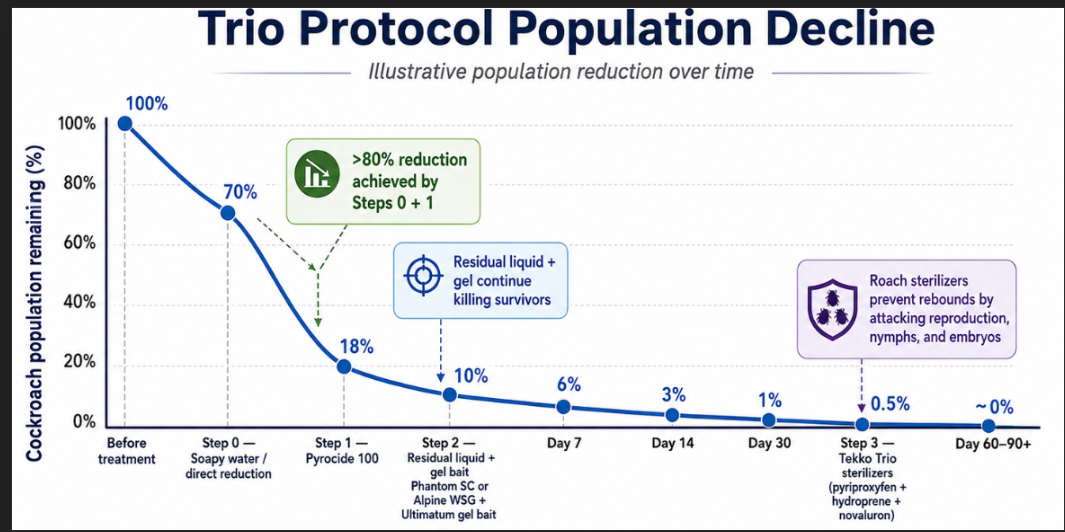
The tool that changes that is an insect growth regulator. IGRs don’t kill adults. They interfere with molting, so nymphs never develop into normal, reproductively viable adults. That’s what actually breaks the cycle, and it’s effectively absent from the consumer aisle.
It also produces a diagnostic no DIY program can give you. Roaches that develop under IGR exposure emerge as adultoids with twisted, curled wings. Two months after treatment, wing shape tells you whether the insects you’re seeing grew up in your unit or walked in from elsewhere in the building.
What you can buy
- Repellent chemistry that scatters the population
- The chemical class they’re most resistant to
- Oil carriers that vanish into porous surfaces
- Bait that dries out and stops being eaten
- No growth regulator, so the colony rebuilds
- No idea how severe it is or where they came from
What the trio protocol does
- Non-repellent chemistry, so exposure accumulates
- Microinjected directly inside voids and motor housings
- Formulation matched to the surface being treated
- Heat-stable gel that stays palatable through summer
- IGRs that shut down the next generation
- Severity graded day one, origin identified at two months
Straight answers.
Why do roaches come back after I spray?
Because the spray treated the insects you could see, not the harborage. Egg cases hatch on their own schedule and each carries roughly 30 to 40 nymphs, so the population reappears two to three weeks later. Repellent sprays also scatter survivors deeper into walls and adjacent rooms.
Do roach bait stations actually work?
Baiting is the right approach, but retail stations fail predictably: the matrix dries out and stops being attractive long before it looks empty, stations get placed in open areas instead of inside cracks and harborages, and some German cockroach populations are glucose-averse and refuse sugar-based baits entirely.
Why doesn’t store-bought roach spray kill them?
Three reasons. It’s usually a repellent pyrethroid they detect and avoid, city populations carry significant resistance to that class, and the oil-based carrier used for shelf stability soaks into porous surfaces so the residue isn’t available where they walk.
Can I use bait and spray together?
You shouldn’t. Spraying on or near bait contaminates the matrix and makes the area repellent, so roaches won’t approach it. The two cancel out, and you lose the part of the program that would have worked.
Do bug bombs work on cockroaches?
Not meaningfully. Foggers deposit on open surfaces and don’t penetrate the voids where German cockroaches live, and they tend to drive the population deeper into the structure. They also carry real fire and inhalation risks.
Is a cockroach problem a sign of a dirty home?
No. Sanitation affects how fast a population grows, but German cockroaches arrive in groceries, deliveries, cardboard, used appliances and through shared walls. Spotless apartments get them regularly.
A Brooklyn-based, NYSDEC-registered company (Reg. #15140) led by Jorge Bedoya, an Associate Certified Entomologist (ACE). For cockroaches, NYE provides a non-repellent microinjection protocol for German cockroaches, placed at the harborage, plus a triple-active IGR. ACE-led work comes with a client portal of service reports and photos, fully bilingual service, and no long-term contract.
Stop buying products. Get it diagnosed.
The professional answer isn’t a stronger version of what you bought, it’s a different strategy: reach the harborage, use chemistry they can’t detect so exposure accumulates, and shut down the next generation. Most cases are finished in a single visit.
$299–$699 · Most resolved in one visit · Led by Jorge Bedoya, ACE · Se habla español
Instant estimate
See your price in 30 seconds.
Service type
Apartment size
How long has it been going on?
The longer it runs, the further it spreads — the single biggest factor in what a job costs.
Free quote · No obligation · Residential NYC · Led by Jorge Bedoya, ACE
When DIY falls short, our ACE-certified exterminators in New York City can diagnose and treat the problem properly.